
Aug. 20, 2026 - Full Show
8/20/2026 | 26m 49sVideo has Closed Captions
Watch the Aug. 20, 2026, full episode of "Chicago Tonight."
How a toll increase could impact your commute and your wallet. And why Illinois lags behind almost every other state in building new housing.
Problems playing video? | Closed Captioning Feedback
Problems playing video? | Closed Captioning Feedback
Chicago Tonight is a local public television program presented by WTTW
WTTW video streaming support provided by members and sponsors.
Aug. 20, 2026 - Full Show
8/20/2026 | 26m 49sVideo has Closed Captions
How a toll increase could impact your commute and your wallet. And why Illinois lags behind almost every other state in building new housing.
Problems playing video? | Closed Captioning Feedback
Where to Watch Chicago Tonight
Chicago Tonight is available to stream on pbs.org and the PBS app.

WTTW News Explains
In this Emmy Award-winning series, WTTW News tackles your questions — big and small — about life in the Chicago area. Our video animations guide you through local government, city history, public utilities and everything in between.Providing Support for PBS.org
Learn Moreabout PBS online sponsorship>> thanks for joining us on Chicago tonight on Brandis Friedman.
Here's what we're looking at.
Illinois tolls are going up starting next year to fund a major construction plan.
A look at what impact that could have.
And Illinois is building new housing at one of the slowest paces in the country.
Whats the hold up and some possible solutions.
>> First off tonight, the Democratic National Convention will not be returning to the Windy City in 2028, the committee announced its first round of host city cuts, eliminating Chicago and Atlanta from the running leadership did not say why the city was dropped from contention, but it would have been unprecedented to host back-to-back nominating conventions after also hosting back in 2024.
Chicago is also bid for the 2032 convention.
But no decision made for that year yet.
Meanwhile, Boston, Philly and Denver are still in the running for the DNC 2028.
Houston will host the Republican National Convention.
Illinois Republicans made their pitch to voters during Republican Day at the state fair.
>> What we're up against is.
It's common sense versus communism.
It really is folks.
>> I want you to challenge if you ever are one-on-one time on one, whatever it is with no Democratic candidate, a Democratic activist just asked them this question.
Are you a capitalist?
Do you believe in capitalism and watch them go >> fairgoers heard from Republican candidates running for statewide office in November's election as well as party leadership in Springfield.
The GOP is criticizing the state's majority party over property taxes, affordability and corruption in politics.
Democrats day at the state fair was yesterday.
The number of new HIV and AIDS cases diagnosed in Chicago could be hitting a low not seen since the Mid 1980's, the Chicago Department of Public Health says preliminary numbers show 504 new HIV cases in 2025. and 236 new AIDS diagnoses.
That's a 38.
And 22% drop respectively compared to 2024. diagnoses also shifted among demographic groups with Hispanic, Chicagoans accounting for 34% of new HIV cases down from 50% in 2024. cdph, though, cautions that these numbers are provisional final data will be published in December of this year.
This news comes on the heels of the protests just yesterday where the AIDS Healthcare Foundation and advocates criticized the city over its handling of the Ryan White HIV AIDS program funds.
How taking the tollway will soon take a bigger toll on your wallet.
It's right after this.
>> Chicago tonight is made possible in part by the Alexander and John Nichols family.
The Pope Brothers Foundation.
And the support of these donors.
>> The commute for many Illinois drivers is going to be more expensive starting next year.
That's because the Illinois Tollway board voted this week to raise fees on motorists by $0.45 per toll starting January.
1st tolls on commercial vehicles are also going up by 30%.
The money is going toward the driving connections plan.
That's a 26.0 5 billion dollar investment in 7, Illinois interstates that will develop and repair roads.
Supporters say the plan will save motorists time by creating new jobs and boosting economic activity.
But opponents worry about increasing costs for residents at a time when affordability is already a top concern for many.
Joining us, our Mary Tyler Transportation director at the Illinois Economic Policy Institute.
And Matt Wells, vice president of the Midwest Truckers Association.
Thanks to you both for joining us.
Mary, the Illinois Tollway board unanimously approved driving connections.
That plan just yesterday.
Talk to us about how much is being invested in what types of projects the money will fund.
>> Oh, well, yeah.
I think you already have highlighted have the top lines 26.5 billion dollar project.
I have to be Frank.
I am not an expert on all the future projects that they are proposing.
going to a lot more detail on that kind of the the benefits of what we see now.
Capital that pass capital program kind of generally then just Yeah, I mean, I think you're obviously in a look at expansion, the continuation of the on eastern access project for 90.
And, you know, general maintenance and things like at the tollway hosted several community listening listening sessions on this plan before the board approved it on.
You attended some voiced her opposition to driving connections.
What are your concerns?
>> We have a number concerns what the tollway is proposed and how they propose to pay Initially, this plan was hastily put together.
They will say that they planned this out for many, many years.
But in all reality, they put this together over the last few months.
After the state legislature essentially approve the idea even though they don't need prove the idea of increasing tolls, 30% in an effort to ease a lot of the labor unions who were irritated about a transfer of funds out of the road fund to fund of the new media Transportation District interim.
>> Mary, you mentioned court that a looking at Illinois Tollway is previous Capitol planned move.
Illinois.
What did you find there?
Yes, or report.
It was with the Illinois Economic Policy Institute.
Did a report on move Illinois Capital program to just really understand the impacts of both on the infrastructure and also on the economic impact of that.
And I think, you know, we can draw conclusions from what happened past Apple program of what we can expect the future capital program will do.
>> But really kind of the top lines are completed, you know, some massive infrastructure projects that people can really, I think see the difference of what was of made, you know, look at the the reconstruction of the central tri-state, which included reconstruction of the mile Long Bridge on.
You know, it's an over 4 billion dollar project.
There is also modernization of I-90 also kind of a key connection point is at I-94 and I-57 was another one that was done.
So, you know, overall we can see have a lot those and and improved congestion.
Reduce that congestion as a personal commuter on to 94.
I can attest to And also let me touch on the economic impact of what we saw.
So this was 15 billion dollars invested over 15 years and that resulted and 28 billion dollars in economic activity.
So you know, on top of just these roadway improvements that we've seen, there's been, you know, huge economic activity and that is it produced 150,000 jobs.
And that's not only just the drive construction workers also kind of industries that support constructions that's engineering or the suppliers of materials.
But then it's also the induced economic activity that's produced.
One more people have jobs.
They're just naturally spending more money in the economy.
And so overall, we can see of a huge economic benefit not only just on on, you know, the actual money invested, but it actually stimulated economy as well.
Matt, what do you make of that?
Does Illinois have much to gain from a plan like this economically?
>> I think there are gains to be realized, but at what That's the question we continue to raise as to why these rates have to go up so quickly.
Groceries are going up 30% to give you an idea how much that really is to bring a truck from South Beloit, Wisconsin to Gary, Indiana, through the tollway system after January one will cost over $90 or truck just use the toy system.
Those costs have to go somewhere.
That means the consumers of those goods are being delivered to.
going to have to pay and increased costs and it's going dry those significantly from the very beginning and the rate at which it's going to go up is going to be difficult for people who are already struggling with fuel prices with grocery prices.
Everything you buy in Chicago comes in on the truck in one form or another and to raise those toll rates.
You're going to see a lot of companies pass those costs on.
Those are eventually going to be paid by the consumer.
But the other concern that we have had with these increased whole rate, even though there may be some realize benefit 15 years down the road is that this will put a lot of pressure on the non tollway tributaries for those carriers that are maybe not in the for-hire truck near a large trucking corporation.
They're not able to raise those rates that are private company that utilizes Bristol trucks.
They're going to try to avoid that always much as possible.
controls costs for the customs.
And we just see that there was a better way to go about this is set up a together.
This large of a 26 and a half million project in a matter of months then just largest rate increase that has ever been done on this whole way.
Those a lot of people to also forget that Russian trucks just seen it away rate increase in 2025.
Even though cars didn't see some So see this was hastily put together.
We do believe that the benefits are going to outweigh the cost in the short term or the next few years.
>> I also want to get your out on the Costa, non-commercial motorists, you know, driving connections raises the cost per told by $0.45 for everybody else.
How do you think that will affect someone who is the toll way to commute to work?
For example?
>> I think they're gonna have to weigh very heavily how much they actually use that away.
I know a lot of people say, oh, it'd be great to be wonderful, but construction is lows dropping down in those costs.
Whenever you're trying to decide how much food to put on the table that we and gas in your car or are you going to use that hallway or an aunt a way around?
I think people are going to choose very carefully over the next few years because it just another cost that people can't seem to stomach this point in time.
>> Mary, a lot of drivers.
They hear construction when they think of traffic delays on and and the road getting a little bit bumpy right when you're shifting lanes so that workers can do what they need to do.
Lane closures detours will 15 years of construction not making congestion worse.
>> I mean, there's always going to be some level congestion related to construction.
But I mean, I think we need to look at it and the broader picture and there's a cost to not investing and the roads.
And if they just continue to deteriorate and they're not taking care of in the way that they should be, it's only going to cause bigger problems longer construction periods in the future.
This is something that we saw with the state of Illinois, you know, prior to the rebuild Illinois capital Bill, passing there went decades without investment and there's a huge amount of backlog and the infrastructure is the son of the Illinois Tollway doesn't have that issue and they actually have 100%.
Other roads are considered an adequate condition.
Compared only 75% of the state's and 50% of them are considered an excellent condition which committed only about 30% of state.
Like I got maintain roads.
So there's you know, there's the cost of not adequately investing.
And I think that Lee has the benefit of these dedicated user fees that they can have a plan in place to ensure that their maintenance is being done in the time that it needs to get to ensure everyone has of good, safe, efficient way to get to work or it's for free to get where it needs to go.
So we did receive a statement in Wt W from the Tollway board it says the concerns of commercial drivers were counted for Matt in the plan.
They said, quote.
>> The toll way took the financial demands on commercial trucking businesses and drivers into account when developing the toll rate updates and driving connections program that continues to say the new long-term capital program will continue to deliver opportunities to improve the driver experience and meet the needs of commercial truckers Matt, do you do not think this plan will also help truckers in the long run by upgrading the infrastructure that they rely on for their jobs.
>> Well, there's 2 things here.
The reality will it help?
I'm not disagreeing.
That probably could be in the long run that the improve road system.
But what we're dealing with is the fact that never consulted with any of the trucking industry professionals about what those stories really would look like.
Also, they made promises a previous capital plans to improve parking along the tollway routes, which is a major concern for the trucking industry is we are federally regulated to stop our trucks and certain times because the federal law requires us to they made a promise.
The last capital plan never happened.
They didn't really make that promise any part of this plan.
Either was just an ancillary, knows like, oh, yeah, we thought about you.
And unfortunately we're standing here with empty pockets and a lot of empty promises that we're going to take into consideration better better routes and traffic for the freight industry.
And we just don't ever see a creation from the >> Okay.
Unfortunately, that's where we'll have to leave Mary Tyler, Matt Wells, thanks to both for joining us.
Best Up next, how oy build more housing?
That's right.
After this.
Home prices in Chicago are rising faster than they have in years.
According to Illinois Realtors, the median sales price jumped to $425,000 in July.
That is 13% higher than last year.
Fewer homes are hitting the market and the ones that do are going fast.
Similar patterns are popping up all around the state as new construction in Illinois struggles to keep up with demand.
Joining us now, our Chloe Groom, a board member for Strong town.
Chicago.
Geoff Baker, the CEO of Illinois Realtors.
And David Doig president and CEO of Chicago Neighborhood Initiatives.
Thanks to all of you for joining us.
I'm David.
Start us off.
Please.
What is the slow pace of housing construction mean for Illinois residents?
Yes, I think it means of a few things.
One is we're not growing.
And so whether that's growing, our economy are growing or population.
>> By not creating enough housing to meet demand.
That's forcing prices up.
So in my mind, a lot of this is very much kind of supply issue.
And if we're not building, then you're of course, you're going to see home right?
Values.
Go up.
You're going to see rents.
Go up.
So we've got to get on a pace to really build you look at other states around the they're they're passing us up.
And and that just marginally.
But by like big numbers.
And so we've got to be intentional.
We've got to be much more specific and directed around building homes at a scale pace that starts to meet the demand.
>> Jeff, what are the barriers?
You see the building new homes.
>> combination of factors, some of which are out of the control Illinois and some of the communities.
But there are things here in our own state that do contribute to the lack of construction.
>> A lot of that is at the local level.
A lot of local regulations, building zoning codes which are >> decades old and haven't been review to refresh and all that time and over time, those have contributed to builders.
Looking elsewhere to build where it's easier and more economical, especially when looking at building certain type policies of homes, missing middle homes, and that's are not just the high income home.
So a lot of the local regulations that you hear about single-family zoning large, lots and then permit review processes that take an extended period of time.
All of that can add up and increase the cost of new homes can forest builders to say that this just isn't worth inIllinois and just so that we're all on the same page when you say missing middle homes year were referring to, you know, homes were middle income families, right?
Like not not necessarily low-income affordable housing.
>> But affordable for people in the middle of Brad Guzan brt, your teachers, firemen, policemen, people with good paying jobs.
>> Chloe, what kinds of housing could Chicago be better at building?
I think the most ironic thing is Chicago could be better building 3 fights for fights which are considered classic Chicago architectural icons.
>> But right now, they're not allowed to be built in more than 60% of the city's residential land.
>> What would be the benefits of mixed housing stock?
Yeah, well, it does kind of you said, it gives regular working people, teachers, childcare workers, service workers, the opportunity to live in their neighborhoods where they work, where >> Where they serve.
>> David, what are some of the unique challenges with trying to build specifically in the city of Chicago?
Yeah, I mean, I think I think there are a number of kind of hurdles.
One is, you know, we have a pretty restricted building code here.
mean, the fact that we still have to use copper for supply.
You know, we've got I think we've issues as sat around zoning.
I think there are issues around labor cost more to build in Chicago.
There's bureaucracy.
And so there's, you know, the time to get a building permit.
There's there's issues around some of the public infrastructure and how do we how do access that?
So it it's a lot of things.
There's no one thing particular that like we can point to and say if we just fix this, that would take care of it.
It's all these things have to work together.
There's got to be an intentionality and a commitment on the part of a public leadership to move this forward.
I think think the mayor has done a good job in terms of this cut the tape initiative.
But we gotta go further like we've got to cut down these these permitting times and and we we need leadership that focuses like a lot more on building and growing.
You know, I think if you look at places like Austin, Texas or Dallas or Denver, the Knicks, I mean, the city are adding 14, 15,000 units a year last year in the city of Chicago.
The building department issued 4200 residential permits for the whole city.
You know, this cities like a 3rd the size of Chicago that are now that that are building twice month and 3 times as many units.
And so how do we how do we start to break down those barriers and allow builders to be able to build that pace and scale so we can start to meet this issue up to me.
And I mean that that's the issue.
And we're never going to solve the affordability problem until we really start to build a quicker pace and a greater scale.
Jeff, give us a sense of the demand, right?
How much building needs to be done?
Much building right the ease.
The crunch.
>> Yeah.
There's a lot of different numbers out there.
But I think the one that we all heard, you know, I think Governor Pritzker was >> using a I think the current shortage is somewhere around 150,000 units be upwards of 250,000 here in a couple years.
But if you look at as they was just saying, the pace of construction, our shortage would require us to triple the amount of new home construction every single year for the next 5 years.
That's just to meet today's demand.
Not 5 ago.
And yes.
>> I'm Chloe.
How much room does Chicago have to grow?
>> Like I said earlier, more than 60% of the city right now doesn't allow anything other than a single-family home starts.
One home for one family.
And a few imagined.
What if we allowed for flats again across all of Chicago, like we did historically, that alone would give so many people so many opportunities and choices.
So undeterred of I I'm really excited about the governor's build plan.
One of the bills.
That's part of that package would.
Re legalize.
Really these classic.
Homes of different sizes and shapes and that would give families across the state of Illinois March >> just one thing on So the city of Chicago has 48,000 vacant.
Lots.
48,000 if you if you built to place for 3 flats, that's like 75,000 new units of housing on already zoned.
You know, lots that would add to our population.
We've got to we've got to start to rebuild our population base.
If you if you go through the West Side or south side, you look at neighborhoods that historically had, you know, 70,000 people where there's now 30,000 people.
>> If you want to begin lot, yeah.
If you want quality retail, you want quality schools, USC prime go down.
>> Yeah, we populated.
Got you've got to put more eyes on the street and and we have the opportunity.
those not like New York or LA which fully built out cities?
I mean, they have no vacant land.
We have lots and lots of vacant land.
But again, it takes it takes leadership and it takes intentionality to build on that.
Whether it's for flat or 2, 3, base existing stores we have the capacity we have the capacity, Jeff Water.
And we heard about the build plan, Jeff Water, Illinois realtors working to change how housing is built.
>> Yeah.
After after the bill didn't come out of the General Assembly, we just this past just a summer launched a housing supply accelerator program.
The idea is to go in the mayor's office is going the city councils all over the state and say we all acknowledge this spring that there was a housing problem.
A lot of local official said that they wanted to try to tackle the problem.
So we created a road map for them.
We created and entire blueprint that can walk them through the entire process to study their own code study all their own processes, figure out where inadvertently created some burdens and then help them develop the solutions that can start to alleviate those burden.
So that accelerate plans out there.
Now I've got an entire team.
Of advocacy professionals that are working with mayors all over the state to start to try to chip away at this.
Well, before we come back to session next year.
>> And we did reach out to Illinois Municipal League and received this statement from their CEO Brad Cole, quote, municipal officials across Illinois remain dedicated to improving housing access and affordability.
But those solution should be developed through local partnerships, not statewide mandates that dictate a one size fits all approach to every community.
The focus on voluntary voluntary locally driven solutions, which we have suggested from the beginning of these discussions demonstrates that meaningful progress can be made on housing while preserving local decision making.
Jeff is local decision making it sounds like it's part of the process.
Part of the approach that the Illinois realtors are taking.
Yeah, entire concept of the accelerator is to let every individual local municipality decide for themselves.
So your city's results may look different than my cities.
>> At the same time, that doesn't mean that there's not statewide action that can't be taken.
There are those the state now controls a lot of minimum building codes.
And so that's something that the state can work on.
The doesn't really infringe on any sort of local control elements.
So well, all our accelerator does preserve that element of local control.
There are still a major role for state law lawmakers as well.
>> Chloe residents of also expressed concerns that development your neighborhood can sometimes lead to displacement.
How can developers take those concerns into consideration?
>> Yeah, I'm will part of storm Chicago does and what strong towns as a national movement is all about is empowering people in their neighborhoods to be small builders.
Homebuilders themselves.
So part of what I really like about the bill, the plan is that, yeah, you can get a conventional mortgage to finance a for flat.
Right now.
Lake, it can work with the house and accelerators that can give a municipality's tools to build resources to help the folks in their cities become homebuilders themselves.
That is where we'll have to leave it.
I'm gonna trust the 3 of you on this >> For joining us, David Dorey Jeff Baker and Chloe Grand Prix.
thank you, France.
>> And that's our show for this Thursday night.
Sign up for our free email newsletter.
Urban nature to stay up to date on environmental news.
local wildlife and much more Tomorrows Edition includes details about a former Barrington Hills horse farm turned nature preserve.
Find out more sign up at Www dot com Slash newsletter and join us tomorrow night at 5.37, for the week in review.
Now for all of us here in Chicago tonight, I'm Brandis Friedman.
Thanks for watching.
Stay healthy and safe.
Have a >> Closed captioning is made possible by Clifford and Clifford Law offices, a Chicago personal injury and wrongful death for that
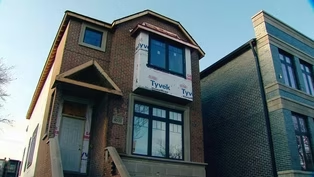 New
NewIllinois Is Building New Houses at One of the Slowest Paces in the US
Video has Closed Captions
Home prices in Chicago are rising faster than they have in years. (10m 28s)
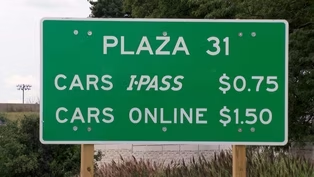 New
NewIllinois Tollway Board OKs Toll Increase as Part of $26.5B Capital Projects Plan
Video has Closed Captions
Critics argued the board is moving too quickly and gave the public little time to weigh in. (10m 11s)
Providing Support for PBS.org
Learn Moreabout PBS online sponsorship New Episode
- News and Public Affairs

Top journalists deliver compelling original analysis of the hour's headlines.

- News and Public Affairs

Today's top journalists discuss Washington's current political events and public affairs.



 New Episode


 New Episode
 New Episode
 New Episode
Support for PBS provided by:
Chicago Tonight is a local public television program presented by WTTW
WTTW video streaming support provided by members and sponsors.