NJ Spotlight News
NJ Spotlight News: March 19, 2024
3/19/2024 | 26m 46sVideo has Closed Captions
Watch as the NJ Spotlight News team breaks down today’s top stories.
We bring you what’s relevant and important in New Jersey news, along with our insight. Watch as the NJ Spotlight News team breaks down today’s top stories.
Problems playing video? | Closed Captioning Feedback
Problems playing video? | Closed Captioning Feedback
NJ Spotlight News is a local public television program presented by THIRTEEN PBS
NJ Spotlight News
NJ Spotlight News: March 19, 2024
3/19/2024 | 26m 46sVideo has Closed Captions
We bring you what’s relevant and important in New Jersey news, along with our insight. Watch as the NJ Spotlight News team breaks down today’s top stories.
Problems playing video? | Closed Captioning Feedback
How to Watch NJ Spotlight News
NJ Spotlight News is available to stream on pbs.org and the free PBS App, available on iPhone, Apple TV, Android TV, Android smartphones, Amazon Fire TV, Amazon Fire Tablet, Roku, Samsung Smart TV, and Vizio.
Providing Support for PBS.org
Learn Moreabout PBS online sponsorshipAnnouncer: Funding for "NJ Spotlight news" provided members of the New Jersey Education Association, making public schools great for every child.
And RWJBarnabas Health, let's be healthy together.
Briana: Tonight on "NJ Spotlight News," one-on-one with U.S. Senate candidate Andy Kim after his day in federal court trying to abolish the county line valid system.
>> We are the outlier, and we do it in a way that allows party leaders to give preferential placement to their preferred candidates, and that is just not fair.
Briana: Plus, making their voices heard during the first public budget hearing in Newark.
No surprise, everyone is asking for more money.
>> To the Walmarts, Amazons, and Wells Fargos, it is time to pay your fair share.
Briana: Gun permits surging in the Garden State nearly two years after the Supreme Court struck down some of the toughest gun law restrictions.
>> Gun violence rates will go up as well.
That is not me saying firearms are bad, but when there are more firearms, there is more gun violence.
Briana: Changes are coming to the way that agents can broker commission fees.
"NJ Spotlight News" begins right now.
>> From NJ PBS Studios, this is "NJ Spotlight News" with Briana Vannozzi.
Briana: Good evening, and thanks for joining us this Tuesday night.
I am Briana Vannozzi.
New Jersey's County party bosses are potentially on the verge of a massive shift to their power after a marathon hearing on Monday in a federal courtroom in Trenton over the constitutionality of the state's ballot design, more often referred to as the party line system.
During nine hours of oral arguments, lawyers representing Congressman Andy Kim, who brought the lawsuit, and others in support of ending the line argue it goes against the pursuit of democracy because it gives an unfair advantage to those who are awarded to the line and prospective candidates have dropped their election bids in the past if they didn't secure the endorsement.
Kim is locked in a heated primary race against First Lady Tammy Murphy for the U.S. Senate seat currently occupied by embattled senior Senator Bob Menendez.
Attorneys for the defendants, the 19 counties that use this ballot structure, argued it is not feasible to change how candidates are grouped on the ballot design before the June election.
The court hearing took place as Murphy nabbed her eighth organization line from Gloucester County Democrats, though it may not matter much after a judge issues a ruling.
I'm joined by the man at the center of this lawsuit, Representative Andy Kim.
Congressman, thanks for giving us a few minutes of your time today.
A whirlwind 24 hours, if I may say that.
Marathon hearing yesterday.
Did you get any indication from the judge how he is leaning after the testimony?
Rep. Kim: Well, thank you for having me.
No, no indication.
He was somebody who was very clear he wanted to be fair about this and really have a structured process.
What I do appreciate the ability for us to be able to make our case and be able to talk about why we think this is unfair and why we think this is unconstitutional.
And I was really proud of our team in terms of what we a were able to put forward.
Briana: You spoke for about an hour, as I understand it.
What was the crux of the argument you presented personally?
Rep. Kim: The crux of the argument is that this is a system unlike any other system in the United States.
49 other states in America use a standard ballot for our elections.
New Jersey does not.
We are the outlier, and redo it in a way that allows party leaders to give preferential placement to their preferred candidates, and that is just not fair.
Organizations, the parties, they can endorse candidates as they would like, but just don't structure that in terms of a ballot line for the elections.
That is what is causing this to be unfair, and that is what we are asking to change.
Briana: The defendants' argument about the timing of this and getting this done in time for the primary was that the main point that they made.
Do you see a clear path to victory if you don't win this case?
Rep. Kim: Well, firstly I want to say that it should be noted how they are really not making an argument countering what I said about the unfairness of this process.
I think that is something that we really need to note, because what was their actual argument on that front?
If it is about viability of what we could get done, we presented that expertise to show it can be done.
Regardless, I will be on the ballot on June 4 and I believe I have a very strong path to victory no matter what happens in the courtroom, and I'm going to continue to push on his heart as I can.
Briana: What was your reaction to the Attorney General's decision to weigh in at the 11th hour, and how much wage do you think it will have on this case -- weight do you think it will have on this case?
Rep. Kim: I'm not sure what weight it will have, but for me as a resident of New Jersey it was powerful to hear our chief law enforcement officer of the state give that strong an opinion about what he assesses.
As someone that is in the highest leadership positions when it comes to these types of issues, I think that is causing New Jerseyans to take note.
How it impacts the court, I do not know, but it was a very important and very courageous step forward.
Briana: Either way, whichever way this case goes, it seems as this this is going to reshape politics.
Do you think this has created an inflection point for Democrats?
Rep. Kim: Well, I think the inflection point has already happened.
I really do believe that Jersey politics has already changed, and it is just a matter of whether or not the political leadership in this state realize it.
Between the indictment of the senator and the Senate primary and what is happening with the attention to the ballots and what we see in the reaction from the public about transparency, we are seeing a change already happening.
I really do think Jersey politics will be different, and it will be changed going forward.
Briana: Win or lose, you see things being different moving forward?
Rep. Kim: Absolutely.
As I said, I think it has already changed, and I'm hoping that we can keep that change going and have it happen fast, because the people are demanding it.
You see that in my 85-pipoint wn in Morris County, 76-point win in Atlantic County.
People are ready for change in New Jersey.
Briana: Congressman Andy Kim, thanks so much for your time.
Rep. Kim: thanks for y having me.
Briana: Arak's group of activists major their concerns were known on the first public hearing on Governor Murphy's proposed fiscal year 2025 budget, calling on the governor to restore a business tax surcharge that expired at the end of the year and accusing the administration of balancing the budget on the backs of hard-working residents.
Senior correspondent Joanna was there.
Joanna: hoping their voices carried inside, advocacy groups rallied on the campus of NJIT this morning as the Senate Budget Committee was hearing on the governor's 2025 budget.
>> To the Walmarts, Amazons, and Wells Fargos, it is time to pay your fair share.
Joanna: they are calling on Governor Murphy to fully restore the business tax surcharge that expired in December, saying the trends if he does not go far enough to tax wealthy businesses given the proposed increase to transit fares.
>> Bus fares are still going up, and senior pass is still going to be cut.
I really don't know how I am going to pay for the increased prices.
>> The budget cannot be balanced on the backs of Black and brown New Jersey communities.
Joanna: Inside the hearing, members of the business community push back on the governor's corporate transit fees, saying he's trying to close NJ transit budget was on the backs of businesses.
>> It is another name for the corporate business tax that just sunset.
It just sunset 11 weeks ago.
The companies were banking on getting the money back to commit to their workforce, their facilities, and communities.
Joanna: They are not the only ones asking for funding to be restored.
School district's are asking for funds to be restored and community colleges asking for cuts to be reversed.
>> For many, community college is the only affordable way to obtain a quality undergraduate education, and this budget hinders that vital opportunity.
I am here today to ask you to restore the 12% cut in funding in the proposed budget and further build upon last year's historic pledge with an increase in funding.
>> $20 million is a hard, hard hit across our system, and it would be a devastating hit to our colleges and frankly, to our students as well.
Joanna: We'd see advocacy groups calling on the governor to restore the corporate business tax.
Do you support that as a way to claw some of the money back for colleges?
>> We don't think that is necessary.
We think there is already money there without putting new taxes.
We go hand-in-hand with business.
We are training future employees and we rely on them as well and they are lifelines of New Jersey.
We believe the money is there.
There is not a need for greater taxation.
Joanna: And school district that lost millions in the final facing of the funding formula pleaded for a plan to restore their cuts.
>> the reduction this year was supposed to be $337,000, so you can imagine our shock and our horror when that $337,000 turned into $4.69 million.
>> South Brunswick as of right now is operating six years later with 30 minute dollars less money.
-- $30 million less money.
Going forward, we need bipartisan -- this is not partisan, kids are not partisan, kids are not written blue.
>> we are seeing district lose 50%, 16% of state -- !5%, 16% state aid.
We need to look at longer-term supports and we are asking to put $2 million towards a task force that can look at the formula.
Joanna: Education funding seemed to stir support from legislators on both sides of the Al who at least today voiced support for Mr. Warren County college funding and coming up with temporary -- for restoring county college funding and coming up with temporary relief for districts before the season ends.
Briana: It has been nearly two years since the U.S. Supreme Court ruling made it easier for people around the country to carry guns in public.
State officials say New Jersey is already feeling those effect.
That ruling said that Americans have a right to carry a firearm outside the home for self-defense purposes.
Undercutting laws in states like New Jersey that required a person to show a justifiable need.
Since then, tens of thousands of people in the Garden state have taken advantage.
Ted Goldberg reports.
Ted: Since the Bruin decision, state data says more than 30,000 New Jerseyans have applied for a concealed carry permit.
>> we thought the numbers would be higher.
You have in excess of 8 million people in the state of New Jersey, the estimate's over a million gun owners.
Ted: RTSP has trained 5000 of them at their two locations.
The co-owner says training for a concealed carry permit is much different than shooting at a range.
>> We want people to get proficient in the actual drawing of the firearm, how you engage a target.
Then we bring them on the range for the qualification and we have been deemed, and that is everything -- not just the rounds on the paper, that is how they draw and go in and out of the holster and how safe they are.
Ted: Before the Bruin decision, New Jerseyans had to meet the legal standards of a justifiable need to concealed carry.
You can see the difference in concealed-carry applications in 20 months free Bruin-- pre-Bruin and post-Bruin.
That has gun-control advocates afraid of what might happen next.
>> The gun industry has been pushing the message that it will.
Ted: The legal director and deputy chief counsel for the Law Center to prevent gun violence is worried that more guns in public will lead to more crime.
>> Interpersonal conflicts that might have been a fistfight would escalate into fatal violence.
We know that will happen more.
People who are carrying guns are more likely to seek out situations where violence results.
>> Firearm access goes up in New Jersey, just as you see universally across other instances, gun violence rates go up as well.
That is not me saying firearms are bad, but when there is more firearms, there is more gun violence.
Ted: This man leads to gun violence Center at Bueckers and he says that other states saw an increase in gun violence when they loosened concealed carry laws.
The number of people from last year is the lowest figure in 15 years.
Ted: The impacts are -- >> The impacts are more profound than they would been in a New Jersey, which is more forward thinking and data driven and how we think about firearm access and the ability of folks to carry in public spaces.
>> Legally purchased weapons are not used for the most part in crime in New Jersey.
Our crime weapons, based upon our data and our analysis, show, and you have heard us say it, that 80% of our crime guns are from outside the state of New Jersey.
Ted: Colonel Patrick Callahan with the state police says there has not been a drastic bump in public shootings or people accidentally shooting their guns.
>> I think responsible gun owners that follow those procedures, that going get their background checks and have that process done and apply for a permit to carry, are just that.
>> people that tend to go through the process and carry are actually very safe.
They understand that they are carrying a firearm, they understand the responsibility behind it.
Ted: In the wake of the Bruin decision, the Attorney General has it suited to uphold state laws banning guns and so-called sensitive places.
His office argued in appeals court in Philadelphia this past October, but that lawsuit is ongoing, just like the battle over concealed carry in New Jersey.
In the union, I'm Ted Goldberg, "NJ Spotlight News."
Briana: Fort Meade is the latest school district in the state to grapple with the gender identity policy known as 5756, which addresses the rights of transgender students.
The policy was enacted in 2017 and informs schools they are not required to notify parents of their child's gender identity.
After going back and for the Bud voting to rescind the policy, the Fort Lee Board of Education decided to ultimately keep it in place.
The decision came after hours of testimony from more than 50 speakers, including trans students who spoke about what the guidelines have meant for them personally.
Critics have said the policy infringes on parental rights, but advocates which included students who are not yet out but submitted letters say it has in some cases the saved their lives.
Despite the number of clinical trials available in the U.S., research shows women are often left out or underrepresented.
That is critical for individuals diagnosed with rare diseases because those trials are frequently their only avenue for care.
Rare medical disorders have few FDA-approved treatments.
Congressman Josh Gottheimer announced a new federal legislation to boost pipelines for clinical trials and help find cures for rare illnesses that disproportionately affect women.
Melissa Rose Cooper reports.
>> as a member of the rare disease caucus in Congress, I couldn't agree more with the agenda here that we have to achieve as a country, making sure we invest more in women's health care.
It is an area that is too often actually left behind where we haven't invested enough, where we haven't done enough, and it is part of why we are here this morning.
Melissa: Congressman Josh Gottheimer joining doctors, nurses, and other health advocates to announce his latest initiative to support women.
Securing equal access to research, care, and health aims to fund treatment for rare diseases that disproportionately impact women.
The Congressman said that legislation will tackle various research challenges including for participation in clinical trials.
Rep. Gottheimer: Since 1994 fewer than 4% of adults in the United States participated in clinical trials despite prolonged improvement efforts.
We try to define people, and people don't raise their hand.
Up to 85% of clinical trials failed to recruit or retain a sufficient sample size.
That leads to failures to meet targets in four out of every five trials.
Melissa: And so rare diseases which impact less than 200,000 people and don't often have FDA-approved treatments, doctors and say it is even harder to maintain proper trials.
>> Not uncommonly, due to the limited understanding of these diseases and the small number of people affected, funding for research is often scarce, making it difficult to find treatment.
For the individual or family with the disease, getting to a diagnosis may be a long and frustrating wrote sought -- frustrating wrote front with prolonged suffering and treatment delays.
>> I the disparities women faced for decades.
Women are overlooked, misdiagnosed, or not diagnosed at all, and it has become clear that legislation of this kind is not only necessary, but critical for women not only with disorders, but for women in the rare disease community at large.
Melissa: Suzanne knows all too well the negative impact of not having access to treatment can have she lost her 30-year-old niece in 2020, who had been battling a rare disease since she was a child.
>> Just last year, 24 years after she was initially diagnosed and almost three years to the day after she died, the FDA approved a new medication to slow the progression.
A breakthrough that arrived too late for my niece, but Mark is significant step -- marked a significant step forward for others.
Melissa: While the Congressman says there has been progress over the years, he says more work needs to be done.
Rep. Gottheimer: 95% of more than 10,000 rare diseases that impact more than 30 million Americans have no FDA-approved treatment.
It's a lot of people.
These rare diseases affect a small amount of people, but when you add them all up, it's lots and lots of people and a lot of families who are affected.
Rare disease research is critical.
Not only can it lead to a cure or treatment for those affected by that disease, but the research can get breakthroughs for the treatment centers.
Melissa: Goals health advocates hope this new legislation will Jeeps are more lives can be will achieve--will achieve so more lives can be saved.
Briana: In our "spotlight on business" report, a major shakeup in the real estate market.
Shifting the 6% fee paid to retailers when buying or selling a home to just a fraction of that.
It comes after the National Association of realtors agreed to pay a landmark $418 million to settle a lawsuits from home sellers who argued commissions were inflated.
Critics also said the long-standing policy helped her to drive home prices higher, but what will it mean for the pockets of those looking to buy or sell a property in the state?
The president of New Jersey realtors recently joined me to talk about the change.
Thanks so much for your time today.
I would like you first get your reaction to this settlement and what it will mean for homebuyers.
>> The settlement right now is a proposed settlement.
It has not been signed off on.
We expected to be potentially signed off on within the next few months.
And the changes that they are talking about will take effect sometime in July.
So right now I don't see many changes happening with regard to the market.
Commissions have never been fixed.
It has always been negotiable.
It is between the listing agent and the seller.
Briana: What will this mean -- is it the end of the 6% rate that a lot of us are talking about?
I know you say it is not fixed, but that is generally the number that these deals are based around.
Doesn't spell the end -- does it spell the end for that?
Gloria: We have not seen any particular numbers f has always been a conversation between sellers and the listing agents.
We haven't had any fixed number.
It is just a matter of how the conversation will be with regard to the listing agent talking with the seller.
Some homebuyers don't have a lot of excess cash to pay commissions, so they just have to wait and see how this pans o ut once the settlement is signed and everything is done.
It is something that I don't want to speculate and say that prices are going to drop.
As of right now the county where my market is, it is 2.5 months worth of inventory.
The housing market would be around six months, so with the scarcity of inventory, prices will remain high.
We just don't know what is going to happen here.
Again, as far as how it would help homebuyers would be pure speculation.
Briana: What are you hearing from your members, from fellow realtors?
Extensively this could be less money in their pockets.
-- ostensibly this could be less money in their pockets.
Gloria: Right now I think they are continuing to do business the way they have done it in the past, and that is negotiating commissions, what works best for the sellers when they talk to the sellers about what the commission rate would be when they list the property.
The difference will be and how things are put into the MLS.
Not having commissions in the MLS will start the conversation for buyers to work with their buyers' agents, they will talk with the sellers' agents to talk about what the commissions will be.
How this shakes out, it has never happened before, so we really can't say.
Briana: A lot to be seen.
Gloria Monks is the president of New Jersey realtors.
Thank you so much.
Gloria: thanks for having me.
Briana: stocks were mixed amid a looming decision by the Fed on interest rates.
>> Support for the business report provided by the New Jersey Chamber of Commerce, announcing its New Jersey business Summit and Expo March 26 and 27 at Harris in Atlantic City.
Details online on njchamber.com.
Briana: That is going to do it for us tonight, but make sure you check out the latest episode of "Off Exit," our new podcast that journeys across the state to share unique slice of life stories from New Jerseyans.
In this episode, producer and host Harrison falcon introduces us to a rising jazz star, a jazz house kids alumnus.
When he is not performing in New York City, he performs regularly in the church van in Wayne, New Jersey.
Download wherever you get your podcasts.
I am Briana Vannozzi.
For the entire "NJ Spotlight News" team, thanks for being with us, have a great evening, see you tomorrow.
>> NJM insurance group, serving the needs of businesses for more than 100 years, And by the PSEG foundation.
>> Look at these kids.
What do you see?
I see myself as a I became an ESL teacher to give my students what I wanted when I came to this country.
The opportunity to learn, to dream, to achieve, a chance to be known and to be an American.
My name is Julia and I am proud to be an NJEA member.
♪

Can NJ homebuyers expect big cuts in realtor commissions?
Video has Closed Captions
Interview: Gloria Monks, New Jersey Realtors president (4m 33s)

Competing demands raised at hearing on Murphy budget plan
Video has Closed Captions
Advocates want business tax surcharge back; business interests decry corporate transit fee (4m 10s)

Gottheimer: Women underrepresented in rare-disease research
Video has Closed Captions
Bill would fund new efforts to enroll women in clinical trials (4m 8s)
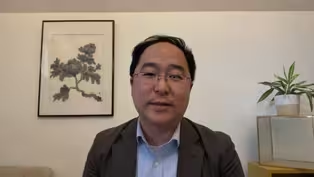
Kim challenges Dem Party bosses on ‘outlier’ ballot design
Video has Closed Captions
Interview: U.S. Rep. Andy Kim discusses the controversial ‘county line’ (5m 57s)
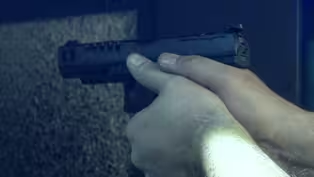
Surge in applications for concealed-carry permits in NJ
Video has Closed Captions
The surge followed a U.S. Supreme Court decision two years ago (4m 10s)
Providing Support for PBS.org
Learn Moreabout PBS online sponsorship
- News and Public Affairs

Top journalists deliver compelling original analysis of the hour's headlines.

- News and Public Affairs

FRONTLINE is investigative journalism that questions, explains and changes our world.











Support for PBS provided by:
NJ Spotlight News is a local public television program presented by THIRTEEN PBS