Here and Now
Paula Tran on the Health Challenges Facing Wisconsinites
Clip: Season 2400 Episode 2448 | 5m 52sVideo has Closed Captions
Paula Tran on findings of the 2025 State Health Assessment for Wisconsin.
Wisconsin Department of Health Services State Health Officer Paula Tran discusses findings of the 2025 State Health Assessment, a five-year investigation into health outcomes and healthcare obstacles.
Problems playing video? | Closed Captioning Feedback
Problems playing video? | Closed Captioning Feedback
Here and Now is a local public television program presented by PBS Wisconsin
Here and Now
Paula Tran on the Health Challenges Facing Wisconsinites
Clip: Season 2400 Episode 2448 | 5m 52sVideo has Closed Captions
Wisconsin Department of Health Services State Health Officer Paula Tran discusses findings of the 2025 State Health Assessment, a five-year investigation into health outcomes and healthcare obstacles.
Problems playing video? | Closed Captioning Feedback
How to Watch Here and Now
Here and Now is available to stream on pbs.org and the free PBS App, available on iPhone, Apple TV, Android TV, Android smartphones, Amazon Fire TV, Amazon Fire Tablet, Roku, Samsung Smart TV, LG TV, and Vizio.
Providing Support for PBS.org
Learn Moreabout PBS online sponsorshipleave it there.
Thank you so much for joining us.
>> I'm so grateful.
Thank you for your time.
>> Turning to health news, 20% of Wisconsinites are self-reporting poor or fair physical health, and 1 in 7 say the same of their mental health.
This is according to the new state health assessment, which comes out every five years.
The Department of Health Services is looking for ways to fill in the gaps.
Steven Potter spoke with the state health officer, Paula Tran for Moore, beginning with what the report is measuring.
>> Overall, we are measuring the things that shape Wisconsinites health as well as the health outcomes.
So we're looking at things like demographic factors who lives in Wisconsin, where they live.
We're also measuring the main causes of death, and we're also looking at all of the factors that really shape an individual's ability to be healthy and well, like economic factors, looking at housing, looking at affordable access to resources that people need, like food and transportation, as well as their access to health care directly.
>> What are the most significant health concerns facing Wisconsinites?
>> Yeah.
Well, we know that Wisconsinites are dying younger than before the pandemic, and we know that there's a lot of challenges for Wisconsinites in accessing both the daily resources that they need to be healthy and well.
So healthy food, having safe, secure housing, having transportation to get them to where they need, as well as having good access to affordable care where they need it, when they need it.
>> One of the key points in your new report is that Wisconsinites feel that there are major obstacles to them receiving health care.
They need to be healthy.
What are those barriers?
>> Yeah, some of the barriers are costs, and access to insurance actually covers all the kinds of care that they need, and cost and insurance kind of go together.
And we know that most people access insurance through their employer.
So if they are experiencing gaps in employment, that might insurance and their for their access to care.
When we look at care directly, we know that in parts of our state, there are gaps in kinds of care.
So hospitals have closed over the last several years and more rural areas.
And even in urban areas, we're seeing clinics and other health care providers closed down or just just based on, you know, the challenges it takes to run a health care organization.
So both getting to care in a way that's accessible and access can be defined again, by cost, by being able to drive to the care or and also having the right kind of provider for the care you need.
>> A large number of residents rated their own health as poor or fair.
About 20% of residents said that.
Why are they feeling this way?
>> Yeah, it again, when we look at all of the challenges that Wisconsinites are facing, we know that overall costs are rising across not just health care, but all daily living needs.
So that is putting a stress on families.
And because our incomes are also being impacted and not rising as quickly for some, with the inflation of other costs, Wisconsinites are being forced to choose between these really important things that they need, whether it's putting food on the table with medications or accessing care because there's a co-payment that they cannot afford.
So all of those things are contributing to how Wisconsinites are feeling and to their health outcomes, that we continue to be challenged around obesity, obesity, hypertension that causes a whole host of chronic diseases.
So there are both the drivers of health that are causing more stress for Wisconsinites and accessing the things that they need to be healthy and well are also exacerbating and allowing other health outcomes to persist.
>> Along the lines of with mental health.
What did your report find?
>> Yeah, we know that Wisconsinites are struggling, they're experiencing stress, and they're also reporting that their mental health is is poor.
And when they need supports around mental health, it's very difficult to access the kind of mental health care that they need.
And we know our mental health care environment has a lot of room to improve around coordinating around different kinds of care, receiving the right referrals for the care you need, and all across the care continuum, making sure we are coordinated so that at any part of the entry of that continuum, folks are accessing early and not allowing some of those challenges to persist, to become worse and potentially be in crisis situations.
>> Your report also measures some good things.
Residents who vote, volunteer, or do favors for others.
Why is it important to measure these things and what did you find?
>> Yeah.
What the current evidence tells us is communities that are more engaged and active and connected to each other, the healthier those communities are.
It both helps from a mental health perspective.
But when in a community, a neighbor is in need of something, they're much more likely to be able to have community support be responsive to those needs.
So there's a lot of different reasons why community connectedness and community engagement and being civically involved helps a community stay healthier and access the resources it needs.
So that's an absolutely great finding for us that more
 New
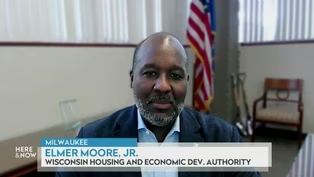
NewElmer Moore, Jr. on Rental Housing Tax Credits in Wisconsin
Video has Closed Captions
Clip: S2400 Ep2448 | 5m 29s | Elmer Moore, Jr. on nearly $50 million in tax credits to build affordable rental units. (5m 29s)
 New
NewHere & Now opening for June 12, 2026
Video has Closed Captions
Clip: S2400 Ep2448 | 1m | The introduction to the June 12, 2026 episode of Here & Now. (1m)
 New
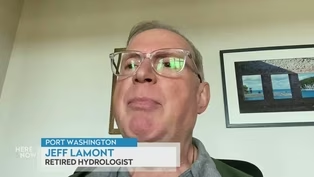
NewJeff Lamont on Wisconsin's PFAS Settlement with Tyco Fire
Video has Closed Captions
Clip: S2400 Ep2448 | 8m 33s | Jeff Lamont on terms of a settlement to address PFAS contamination in the Marinette area. (8m 33s)
 New
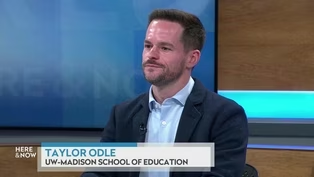
NewTaylor Odle on the Universities of Wisconsin's Tuition Hikes
Video has Closed Captions
Clip: S2400 Ep2448 | 5m 58s | Taylor Odle on what the Universities of Wisconsin increasing tuition means for the state. (5m 58s)
 New
NewWisconsin's U.S. Senators on War with Iran and Inflation
Video has Closed Captions
Clip: S2400 Ep2448 | 1m 48s | Tammy Baldwin and Ron Johnson on the war in Iran and effects on fuel and fertilizer costs. (1m 48s)
Providing Support for PBS.org
Learn Moreabout PBS online sponsorship New Episode
- News and Public Affairs

Top journalists deliver compelling original analysis of the hour's headlines.
 New Episode
- News and Public Affairs

Today's top journalists discuss Washington's current political events and public affairs.

 New Episode
 New Episode
 New Episode
 New Episode

 New Episode
 New Episode
 New Episode
Support for PBS provided by:
Here and Now is a local public television program presented by PBS Wisconsin