
October 14, 2026 - PBS News Hour full episode
10/14/2026 | 57m 46sVideo has Closed Captions
October 14, 2026 - PBS News Hour full episode
October 14, 2026 - PBS News Hour full episode
Problems playing video? | Closed Captioning Feedback
Problems playing video? | Closed Captioning Feedback
Major corporate funding for the PBS News Hour is provided by BDO, BNSF, Consumer Cellular, American Cruise Lines, and Raymond James. Funding for the PBS NewsHour Weekend is provided by...
October 14, 2026 - PBS News Hour full episode
10/14/2026 | 57m 46sVideo has Closed Captions
October 14, 2026 - PBS News Hour full episode
Problems playing video? | Closed Captioning Feedback
Where to Watch PBS News Hour
PBS News Hour is available to stream on pbs.org and the PBS app.
Providing Support for PBS.org
Learn Moreabout PBS online sponsorshipAMNA NAWAZ: Good evening.
I'm Amna Nawaz.
GEOFF BENNETT: And I'm Geoff Bennett.
On the "News Hour" tonight: Rising gas prices drive inflation higher, adding to Americans' cost of living concerns weeks before the midterm elections.
AMNA NAWAZ: Ukraine accuses Elon Musk of restricting his Starlink Internet systems and undermining troops on the front line against Russia.
GEOFF BENNETT: And Judy Woodruff explores how immigration to the U.S.
and the policies governing it have evolved throughout U.S.
history.
NANCY FONER, Author, "Immigration: How the Past Shapes the Present": Immigration has been tied into our history for so long.
So to see this rejection of immigrants, this victimization of immigrants is very, very concerning.
(BREAK) GEOFF BENNETT: Welcome to the "News Hour."
With the midterm elections just three weeks away, a new inflation report shows prices rising faster than expected, putting more pressure on Americans struggling with the cost of everyday essentials.
AMNA NAWAZ: Prices climbed 3.7 percent over the past year and by more than half-a-percent in just the last month.
It's the largest monthly increase in five months.
The price increase was driven by gasoline, up 9 percent in September.
For more on all of this, I'm joined by Heather Long.
She's vice president and chief economist at Navy Federal Credit Union.
Great to see you.
HEATHER LONG, Chief Economist, Navy Federal Credit Union: Good to be here.
AMNA NAWAZ: Well, let's start with that headline number, Consumer Price Index rising 3.7 percent from a year ago, rising faster than a month ago.
How much of that is due to those rising gas prices?
HEATHER LONG: Yes, that's the key question.
Half of it is coming from the high gas and diesel prices.
But, honestly, the reason most people gasped today when they saw this data is because the other half is coming from everything else.
Sure, it's spilling over into higher airfares and higher home heating oil, but the war in Iran is not causing medical care, dental care, toys, apparel.
I hope nobody's shopping for a suit.
Those really jumped up.
Software prices.
There were just so many items, repairing a car, that rose, and that's what really caused the alarm bells today that this is way more broad-based than we thought, and that's going to take a long time to ease.
AMNA NAWAZ: We saw core inflation, which excludes those energy and food prices, also edging higher.
What does that say to you?
HEATHER LONG: Yes, it says that this is more than a gas and oil problem, and that it's going to be harder to get it down than we expected.
The Federal Reserve will have to raise those interest rates again.
It's already a pain point with the mortgage rates back above 7.5 percent.
And so that's the pain that a lot of Americans feel, and probably the most important data point today, and people are feeling it, inflation up 3.7 percent, wage growth only 3 percent.
AMNA NAWAZ: And that combination of the higher inflation, weaker wage growth, we have talked about it before.
I want to take a listen to what two people, Andrew Larcher in South Dakota, and Craig Underwood, who's a farmer in California, had to say about the pressure they're feeling.
ANDREW LARCHER, Sioux Falls, South Dakota, Resident: I'm on VA disability as a 100 percent disabled veteran.
And, given, when I get a month, I used to be able to afford things easily.
Now it gets to the point to where I have to really watch my budget.
How much food can I afford a month, or how much -- or if I buy this much food, can I pay rent?
Or can I afford the car?
I don't have a car right now because there's no way that I can afford a car.
CRAIG UNDERWOOD, Fillmore, California, Resident: It's pretty hard for us to budget for a dramatic increase in the cost of diesel.
It grinds on you know.
When I wake up in the morning, I'm thinking about it.
When I go to bed at night, I'm thinking about it.
Trying to put it out of my brain in order to sleep.
But you do think about it a lot.
AMNA NAWAZ: Heather, people are clearly feeling this pressure in lots of ways.
Are we seeing consumers pull back or start to pull back on their spending in a significant way?
HEATHER LONG: The pain is definitely real right now.
Since President Trump took office again, there's been no wage growth once you adjust for inflation.
And we already see the strain, and you could hear it in some of those clips.
People in the bottom 30 percent don't have any extra money and are reliant on credit cards and starting to miss payments.
The real question is, how long can the middle class hold on?
They have been surprisingly resilient, but we see more and more stories at Navy Federal Credit Union, just like that first clip you played, of people who are pulling back on groceries in order to try to have enough money to pay their other bills.
You can see them stretching every dollar.
You can see them making those hard choices.
We think it's going to be a more tepid holiday season as the hard choices are here.
AMNA NAWAZ: We should also mention Social Security benefits will see a bump in January.
The cost of living adjustment is going to go up by about 3.6 percent.
It's about $75 a month on average.
It's the largest increase in three years, and it is a few months away.
But what kind of a difference can that make, and for whom?
HEATHER LONG: Well, there's obviously a lot of people living on fixed incomes who are struggling right now.
But, as you mentioned, 3.6 percent is the highest in three years.
There's a lot of hope that inflation won't go much higher from here.
But the question is, how much relief do we get in 2027?
As we were talking about, there's a lot of parts of the economy that are really hot inflation right now.
You can't just coupon your way out of that.
AMNA NAWAZ: Heather Long, vice president, chief economist at Navy Federal Credit Union, thanks for being here.
HEATHER LONG: Thanks.
GEOFF BENNETT: And we start today's other headlines with the latest from the Middle East.
Iran says a cargo ship sank after hitting a mine in the Strait of Hormuz.
State TV aired footage today claiming to show the tanker on fire, though this video has not been independently verified.
It's the first time Iran has reported such an incident since the war started.
Separately, Iran-backed Houthi rebels in Yemen say they struck the headquarters of Aramco, the Saudi state-owned oil company.
No injuries were reported.
And Saudi Arabia says it intercepted two ballistic missiles in Riyadh just days after the Houthis repeatedly struck the city's international airport.
The Houthis vowed to continue targeting such facilities in the coming days.
The Vatican says Pope Leo is eating and walking again following surgery to remove a cancerous portion of his lung.
Officials say his recovery is proceeding as planned.
The 71-year-old pontiff was diagnosed with a common form of lung cancer that is often highly treatable when detected early.
Leo is scheduled to visit Latin America next month, including Peru, where he spent two decades as a missionary.
The U.S.
Supreme Court heard arguments today in a privacy case rooted in the era of VHS tapes, but with major implications for privacy in the digital age.
At issue is the Video Privacy Protection Act of 1988, which barred video rental stores like Blockbuster from disclosing their customers' rental histories.
Congress passed the law after a reporter obtained the video rental records of Robert Bork during his unsuccessful nomination to the Supreme Court.
Today, the justices appeared open to allowing a Tennessee man's privacy lawsuit to move forward.
The man argues that the sharing of his online viewing information with Facebook violated the decades-old law.
Archaeologists say they have discovered what may be the world's oldest known shipwreck dating back some 4,700 years.
The ship itself has long since disappeared, but roughly 30 clay jars remain intact on the seafloor.
Their distinctive shape dates them to the Bronze Age, around the time the Pyramids of Giza were built.
Researchers believe the jars originated in the Jordan Valley and likely carried olive oil or wine when the vessel sank along an ancient trade route.
The expedition's leader calls the discovery -- quote -- "a time capsule at the bottom of the sea."
In the business world, Netflix is cutting about 1,000 jobs, or 6 percent of its global work force.
The streaming giant says most of the cuts will affect the company's tech, legal, and human resources teams, among others.
Netflix has struggled to boost user engagement amid a rise in streaming competition.
Its stock ended a touch higher today.
Elsewhere on Wall Street, stocks dropped after the latest rise in inflation.
The Dow Jones industrial average fell less than 50 points.
The Nasdaq dropped almost 2 percent.
The S&P 500 posted its fifth loss in the last six sessions.
And famed soprano Martina Arroyo has died.
With her luminous voice and ease on stage, the Harlem native broke barriers as one of the first major Black opera stars in the 1960s and '70s.
She was also familiar to the nation's TV viewers at the time as a frequent guest on Johnny Carson's "Tonight Show."
In 2013, she was honored by the Kennedy Center, just one of her many awards.
Speaking to PBS in 2015, she reflected on her breakout years at New York's Metropolitan Opera.
MARTINA ARROYO, Opera Singer: The audience will not let you down if you do what you're supposed to do, especially a New York audience.
I think the New York audience is one of the best in the world.
I have been in many other opera houses for the first time and people -- and well greeted very well, greeted very, very well, but not like when the New York people say, you got it, run with it.
GEOFF BENNETT: Arroyo announced her retirement in 1989 and devoted herself to teaching.
She died yesterday in her home in Manhattan.
Martina Arroyo was 90 years old.
Still to come on the "News Hour": the attorney representing news organizations barred from the White House weighs in on the latest legal showdown over press access; Cornell University suspends fraternity parties amid investigations into sexual assault allegations; and political strategists on the state of the races and what's at stake with the midterm elections just weeks away.
AMNA NAWAZ: A key component of Ukraine's communications network was partially disabled today, perhaps by its ally the United States.
The Starshield satellite network, funded by the Pentagon and operated by Elon Musk's SpaceX, was not operating at full capacity today, hampering communications within the Ukrainian military.
Liz Landers has that story.
LIZ LANDERS: Overnight in Kyiv, homes engulfed in flames, as rescue workers rushed to put out the blaze and save the victims of Russia's latest brutal onslaught, as it continues to target Ukraine's energy infrastructure, plunging the nation's capital into darkness.
This comes just three days after President Trump announced on TRUTH Social a -- quote -- "energy cease-fire" in the war between Russia and Ukraine and that -- quote -- "both parties have agreed."
Since Trump's announcement Sunday, Russia has struck at least 26 energy facilities across Ukraine.
And the war-weary nation feels it is being abandoned by its ally, President Zelenskyy told Piers Morgan today.
VOLODYMYR ZELENSKYY, Ukrainian President: We are a losing strong partner.
So this is my opinion.
And... PIERS MORGAN, FOX Nation Host: You think you're losing America?
VOLODYMYR ZELENSKYY: Yes, but not because of us.
We -- I mean this.
We can't be weak.
Otherwise, we can't survive.
It's painful when President Trump chooses one side, not our side.
But we are OK that he's in the middle.
But if you're in the middle, you have to stay in the middle, not on the wrong side.
I think his advisers are wrong.
I don't know who is pushing him not to the right side.
This is not right side of history.
LIZ LANDERS: As the two allies' relationships shows signs of fraying, Ukraine has accused the United States of not providing advanced warning of the Russian strikes, although the Ukrainian president told NPR it was a -- quote -- "technical glitch," and of temporarily limiting their usage of the Starshield satellite system, a military version of the Starlink network, which is integral to Ukraine's targeting of Russian military installations within Russian-occupied Ukrainian territory.
Starshield's thousands of satellites provide Ukraine with the broadband connection needed to find and target Russian military equipment and personnel across Ukrainian territory, along with data for interceptor drones that take down Russian attacks, that ability severely curtailed, as President Zelenskyy stressed today.
VOLODYMYR ZELENSKYY: It's a big mistake, a lot of losses.
This decision will bring a lot of human losses.
PIERS MORGAN: People are dying because of this decision?
VOLODYMYR ZELENSKYY: Of course.
People will die, of course, if attacks will continue and if Starlink will not work.
Of course, I mean, this -- it's not helpful.
So my message is, absolutely, I hope that it's mistake, maybe huge technical problem.
I don't know.
But we are asking to do it, to switch on.
LIZ LANDERS: Late today, former Defense Minister Mykhailo Fedorov posted on X that Starshield link connectivity is being -- quote -- "restored," to which SpaceX CEO Elon Musk responded on X that -- quote -- "Any limits on speed or usage are decided by the U.S.
military and ultimately POTUS," as Ukraine grapples with a war and an ally it fears it can no longer depend on.
For the "PBS News Hour," I'm Liz Landers.
AMNA NAWAZ: For more on all of this, we turn now to retired rear admiral mark Montgomery, who served on the National Security Council staff, later on the Republican staff of the Senate Armed Services Committee.
He's now a senior fellow at the Foundation for Defense of Democracies.
Admiral, welcome back to the "News Hour."
Let's just start with some context here.
How crucial is this Starshield satellite system to Ukraine's war effort?
What does it allow them to do offensively and defensively?
REAR ADM.
MARK MONTGOMERY (RET.
), Foundation for Defense of Democracies: So the Starshield system, particularly in this, what we're talking about here, which is operating over Russian-occupied Ukrainian territory, is critical to what you call mid-range strike, the ability to hit, say, the logistics lines that flow Russian equipment and supplies into Crimea and the logistics and command-and-control that support their frontline units.
So that mid-range strike is really critical to the military resilience right along the front line where the two forces are engaged.
But you can't understate the criticality of maintaining communications with the mid-range strike drones before they hit their targets.
AMNA NAWAZ: So if those communication systems are limited, if they are throttled, if they are slowed down, what is the practical impact of that on the ground?
You heard President Zelenskyy there say people could die as a result.
Is that true or is that hyperbole?
REAR ADM.
MARK MONTGOMERY (RET.
): Absolutely.
In the case of this, the people are Ukrainian military personnel, because this mid-range strike is really about hit hitting assets to support the Russian military in conducting operations against the Ukrainian corps and task force along that fortress belt.
So they will lose -- if they don't conduct these strikes, they will eventually lose personnel.
AMNA NAWAZ: So it does seem now as if that service, those communications are mostly back up.
You heard President Zelenskyy also say he hopes the limitation there was a mistake or could have been a technical glitch of some kind.
Do we know for sure if there was an intentional decision behind that slowdown or if this could have been a technical issue?
What's more likely here?
REAR ADM.
MARK MONTGOMERY (RET.
): So we don't know for sure yet, and we may not know until we hear on TRUTH Social.
But I think the most likely thing is a strong signaling message from President Trump to President Zelenskyy: Don't complain about my actions with regard to Russian diesel fuel, and don't -- don't strike Russian refineries probably at least through the end of the elections, our midterm elections.
AMNA NAWAZ: And based on what you know about how this company works, how those satellite systems work, would a decision like that have to come from the U.S.
president?
Could it have been made by Elon Musk himself?
REAR ADM.
MARK MONTGOMERY (RET.
): No, I think Starshield is run -- that -- Elon Musk's X statement was true that Starshield's operations on a day-to-day basis are run by the U.S.
military, the U.S.
government.
AMNA NAWAZ: As you mentioned, those Starshield communication systems, they provide data to the Ukrainian drones flying over Ukraine and also over Russian-occupied Crimea.
Do you believe those limitations should be lifted?
Should those communication systems enable further use of Ukrainian drones?
REAR ADM.
MARK MONTGOMERY (RET.
): Absolutely.
I mean, what we're talking about here is those mid-range drones.
Their long-range drones operate over Russian sovereign territory.
It's very reasonable for them to have access to this communications to conduct purely defensive strikes.
And by that, I mean striking Iskander missile launchers, ballistic missile launchers, before they launch.
So you hit the archer, instead of the arrow, or hit stowage sites for ballistic missiles and other offensive Russian weapons.
You know, so that's a reasonable ask of Starshield and Starlink.
And, in fact, prior to this, there was some effort being made by the U.S.
Congress to ask the president to engage Elon Musk on this.
AMNA NAWAZ: If these communication systems were throttled intentionally now, do you believe that could happen again?
REAR ADM.
MARK MONTGOMERY (RET.
): Oh, absolutely.
That's the signal.
The signal is, if Ukraine strikes energy Russian refineries, they can inspect some throttling.
If I were President Zelenskyy, I'd tell my operational planners, hey, do me up a great four-week plan where I strike everything every piece of infrastructure in Russia except refineries.
Vladimir Putin's critical infrastructure is vulnerable in many, many places, not just the refineries.
AMNA NAWAZ: That is retired Rear Admiral Mark Montgomery joining us tonight.
Admiral, always good to speak with you.
Thank you for your time.
REAR ADM.
MARK MONTGOMERY (RET.
): Thank you.
GEOFF BENNETT: A federal judge has once again ordered the White House to restore access for three news organizations President Trump banned last month over their coverage of his administration.
In a ruling issued late last night, the judge ordered the White House to restore full access for CNN, MS NOW, and Politico while their legal challenge moves forward.
The order remains in effect until the judge reaches a final decision or a higher court intervenes.
Joining us now is Ted Boutrous.
He is the attorney representing CNN, MS NOW, and Politico.
Thanks for being with us.
THEODORE BOUTROUS, Attorney for Media Outlets: Thanks for having me.
GEOFF BENNETT: So, walk us through this ruling.
What did the judge find most troubling about the White House's actions and what does all of this mean in practical terms?
THEODORE BOUTROUS: The judge ruled on two fundamental questions, first found that we were likely to succeed on our due process claim, which is that President Trump, out of the blue, without any notice, without any notice of the standards that might cause someone's hard pass to be taken away at the White House and to be banned from the White House grounds, took away their hard passes, announced what he called this ban on the free press.
And the Due Process Clause requires fair notice and an opportunity to be heard when the liberty interest like the First Amendment is being taken away by the government.
And there are D.C.
Circuit cases at the Court of Appeals on this very issue.
So the court said we were likely to win on that because none of my clients had any notice of anything and they didn't do anything wrong.
The second fundamental question the court addressed were the First Amendment issues.
And this is really important, because the court ruled that the stripping of the hard passes and banishment from the White House was done first in retaliation for free speech and for First Amendment activity by MS NOW, CNN and Politico and their journalists.
President Trump didn't like what they were reporting, and that he took away their credentials to lash out and retaliate.
GEOFF BENNETT: Our team reached out to the White House for a statement.
And they responded by saying, in part -- quote -- "The fake news has no place demanding a spot in the president's Oval Office."
Now, the White House argues that news organizations have no inherent right to access the president, which is true.
So where do you draw the line?
Where's the constitutional line, I should say, between a president's discretion to determine who gets access and unlawful retaliation against journalists for their coverage?
THEODORE BOUTROUS: It's a really great question, and the judge addressed that, that the test is, has the government opened up a government building to First Amendment activities, what's called a nonpublic forum?
And, if it does that, if it says, look, normally, we keep this closed to the press and to others, but we do open it up and we allow people in here, journalists, to ask questions and engage in journalism, once that happens, the Constitution, the Supreme Court cases, the D.C.
Circuit cases, talking specifically in the D.C.
Circuit's case about the White House press facilities, require that the restrictions be reasonable on those who are allowed in who have press credentials here, and also that they cannot be thrown out because of their viewpoint.
It has to be -- those restrictions have to be viewpoint-neutral.
So the White House, in their statement, they're just playing right into our hands.
They're basically confirming what the judge said, that the reason that the press passes were vacated by President Trump is because he doesn't like these news organizations and what they publish and broadcast.
And that is a fundamental First Amendment violation, and the judge found we were likely to win on that as the case moves forward.
GEOFF BENNETT: A question about the precedent this could set, because this White House, this Trump White House has granted access to a number of pro-Trump MAGA-friendly outlets.
If a future Democratic administration excludes those same organizations because it objects to their legitimacy and objects to their coverage, would that raise the same First Amendment concerns?
THEODORE BOUTROUS: It absolutely would.
And that's why you see such solidarity among news organizations and journalists.
The Reporters Committee filed an amicus brief, with 77 news organizations joining, including from all across the political spectrum, if we want to call it that.
The head of the White House Correspondents' Association, the president this year is Jacqui Heinrich from FOX News.
She's been advocating against these restrictions and these banishments because it's a two-way street.
If one president can do it, another president can do it.
And that's not what the First Amendment is all about.
It's really an equal playing field.
It doesn't take sides.
That's the whole notion of why you can't have viewpoint discrimination.
So it's really counterproductive.
President Trump can spar with these reporters.
He should just go back to normal and spar with reporters, answer their questions, instead of lashing out like this and banishing news organizations and reporters because of what they publish and broadcast.
GEOFF BENNETT: Attorney Ted Boutrous, thanks again for joining us this evening.
We appreciate it.
THEODORE BOUTROUS: Thanks for having me.
And a note that PBS News is among the more than 70 news organizations that signed a legal brief supporting the effort to restore White House access for CNN, MS NOW, and Politico.
AMNA NAWAZ: The fallout from the 2024 sexual assault allegations at Cornell University continues.
Tonight, faculty members plan to introduce a resolution of no confidence in how the university's leadership handled an alleged gang rape at the Chi Phi fraternity.
The Jane Doe in that case is suing the university and has accused seven men of the assault, all of whom deny any wrongdoing.
Cornell has since banned the Chi Phi fraternity.
And university President Michael Kotlikoff suspended all fraternity parties through the end of the academic year.
He also committed to a thorough review of fraternity life at Cornell to determine whether and how it can safely continue.
For more now, we turn to Jud Horras.
He's president and CEO of the North American Interfraternity Conference, and to John Hechinger.
He's a deputy managing editor of Bloomberg News and author of the book "True Gentlemen: The Broken Pledge of America's Fraternities."
Welcome to you both, and thank you for being here.
And, John Hechinger, I will begin with you because the Cornell case is forcing a closer examination of fraternities in America.
In your view, based on your work, is this case an outlier or is it indicative of a larger culture or pattern of behavior within fraternities?
JOHN HECHINGER, Deputy Managing Editor, Bloomberg News: Well, I think it's a particularly horrific example of a pattern of behavior that I have seen throughout my research.
If we're talking about sexual assault, fraternity houses are a dangerous place for women.
My research shows that women who go to fraternity parties run 1.5 times the risk of sexual assault, and sorority women who are most exposed to fraternity parties run three times the risk of rape.
And in my book, I looked at one very one large fraternity.
I looked at 230 chapters over five years and found 15 examples of sexual assault.
As with the case in Cornell, most of them kind of did not receive any kind of reckoning.
I only found one case where anyone was -- faced criminal charges.
So this is definitely a broader problem in fraternity life that I think now is -- people are starting to address.
AMNA NAWAZ: Jud Horras, I'd love for you to respond to that.
Does this deserve more attention and scrutiny?
JUD HORRAS, President and CEO, North American Interfraternity Conference: Well, let's start with Cornell.
Those men, directly and indirectly, they agreed to a higher standard by being a fraternity man, and they completely failed that.
The closure of the chapter, the expulsion of members is the right decision.
Let's let the courts play out on the rest.
But we know that.
We also know that there's a quarter-of-a-million young men in a fraternity today in college.
And the vast majority of them are having a wonderful experience.
But specific to fraternities, we have to take accountability for any problems that we create.
But it's important to note, even Cornell in their study, follow-up study, said you were twice as likely to have sexual misconduct happen in a residence hall on campus than you were in a fraternity house.
So we have to lead the change.
So many of the undergraduates I talked to are angry about what happened at Cornell, that it represents -- in some way is connected to them.
And we are redirecting that anger into addressing cultures on their campus and in their chapters.
AMNA NAWAZ: John Hechinger, respond to what you just heard there, especially in terms of the idea that there are similar crimes, similar misconduct being carried out across college campuses, not necessarily just at fraternities, which is an alarming issue we can talk about separately, but why the focus on fraternities in your view?
JOHN HECHINGER: There's a sort of disproportionate amount of drinking and sort of out-of-control behavior at fraternities.
Fraternity men and sorority women are among the heaviest drinkers on campus, and fraternity men are hosting parties where there's an enormous amount of underage drinking that's not well supervised; 75 percent of the people in fraternities are underage.
And yet they're kind of the hosts and the unofficial bartenders at -- on most campuses.
And what people in public health told me is, that's kind of a recipe for a dangerous environment, where sexual assaults are likely to happen.
And, again, I would point out that Cornell found that half of the women and affiliated with sorority life said they were they were subject to sexual assault, which was almost twice the level of those who weren't.
So I think there's -- there is a disproportionate risk there.
And I think that's why people are so concerned.
AMNA NAWAZ: Jud, go ahead.
JUD HORRAS: Well, again, you're citing what sorority women -- it doesn't say who did it.
And this is kind of, I think, confirmation bias sometimes people have.
Let's look at the facts.
We advocated for a federal law that was enacted two years ago, along with parents who've lost sons to hazing.
Part of that is, you have to list all student organization discipline.
So if you go to the Cornell Web site, as an example, which is consistent, five of the seven student organizations listed last year for hazing were not all-male fraternities.
They were sports clubs and other business fraternities that are co-ed.
So we have to take responsibility for our actions, no doubt about it.
That's why we're advocating for -- on hazing specifically, we have had a dozen states where we have advocated and got stronger felony criminal laws.
Part of our approach is, we are -- we have to hold individuals visibly and publicly accountable for this behavior, because we can do prevention work, which we do, and invest millions of dollars in it.
But if students see other students get away with bad behavior and not be held accountable, all of the prevention work is useless.
AMNA NAWAZ: We're focusing a lot on Cornell here, Jud, but there's been other headlines people have been focusing on.
There was the University of Arizona that said this month it was suspending fraternity activity after misconduct reports.
There was an 18-year-old who died during hazing at Northern Arizona University.
There were 14 people arrested at Penn State for running a cocaine trafficking ring out of two fraternities.
Taken together, do these suggest to you a deeper problem or a series of isolated incidents?
JUD HORRAS: Well, look, any student that does cocaine trafficking needs to be held criminally accountable.
And so I see that and the Northern Arizona situation as confirmation that individual accountability, very publicly.
And in cases of sexual misconduct, they're charged with a crime very publicly, students have to see this as unacceptable behavior.
I want to be clear, we accept that we are a part of a culture and a system that we have to address.
That's why we have done so much work on state laws, on federal laws, on prevention work.
But I tell everyone, when you work with 18-to-22-year-old men, you are constantly every year inheriting a new group of freshmen.
Prevention education is critical.
Individual accountability and group accountability is critical.
So we accept that.
But another statistic people have to keep in mind, nearly 1,500 students died last year from alcohol-related injuries.
Not all of those are in fraternities and sororities.
The value that we're providing to young men, even today, in the middle of all of this, we have record enrollment, is enduring, and that's what fraternity is about, is doing the positives.
It's a lifelong brotherhood and connection.
It's helping them with career readiness.
It's addressing a lot of the mental health challenges in young men today and the desire to even go to higher ed.
AMNA NAWAZ: John Hechinger, I have less than a minute here.
But we said that we saw the Cornell president says he's going to carry out a thorough review.
Jud Horras has been talking about accountability.
What kind of reforms, what kind of kind of ability should come out of this review?
JOHN HECHINGER: Well, I think that there has to be a really hard look at whether fraternities can responsibly serve liquor at events on campus.
And I think what Cornell has shown is that that's been a real problem.
And I think the fraternities and the universities that have made -- have made a real difference in terms of behavior have cut back on alcohol abuse and really alcohol at parties.
So the question is whether fraternities can kind of disengage and disentangle the brotherhood that Jud is talking about from some of these kind of darker impulses that they have that's often fueled with out-of-control drinking and drug abuse.
And, yes, people can be held individually accountable, but it's pretty hard to do that on a case-by-case.
The police aren't usually equipped to police underage drinking.
Sexual assault is often not investigated, as we have seen.
So, I mean, many people that I spoke to for the book saw this as a public health problem.
And a public health problem often involves changing a campus culture, a drinking culture.
And the heaviest drinkers on campus are at fraternities and sororities.
So, if you want to cut back on that, you have to cut back on the drinking in Greek life.
There's no way around it.
AMNA NAWAZ: Certainly lots more to discuss here.
We will have to leave it there for now, though.
Thank you to you both, John Hechinger and Jud Horras, for being here.
JUD HORRAS: Thank you.
JOHN HECHINGER: Thank you.
GEOFF BENNETT: Well, the latest polling for the upcoming midterms shows a tilt in Democrats' favor.
For an insiders' view of the final weeks of the campaigns, we turn now to the insights of Democratic strategist Mo Elleithee and Republican Doug Heye.
It's always great to see you both.
DOUG HEYE, Republican Strategist: Thank you.
MO ELLEITHEE, Democratic Strategist: Hey.
GEOFF BENNETT: So, Doug, Republicans are asking voters to give them two more years of unified government.
Beyond defending President Trump, what's the affirmative case they're making for what they would actually do with that power?
DOUG HEYE: I think the tough reality for them is, there's not much more that they're able to do because of that.
And in large part, that's because of Donald Trump.
He so dominates the call the conversation all day, every day, usually with things that aren't on topic for what candidates want to be talking about.
If I'm Michael Whatley in North Carolina or Ashley Hinson in Iowa, I want to be talking about, here's what Republicans have done to lower costs, and here's what they're going to do over the next two years.
But the reality is, it's harder for them to have that conversation because of the self-created Trump outrages du jour that may be happening right now while we're shooting this and we're unaware of it.
But the reality with Donald Trump is, these happen all the time.
GEOFF BENNETT: And, Mo, there are echoes of 2006 here.
You have got an unpopular war, a president with low approval ratings, a midterm election that has become a referendum in many ways on this White House.
Democrats picked up 31 House seats that year.
What's different this time, if anything?
MO ELLEITHEE: Well, look, I think Donald Trump makes everything different, right?
And he has for the past decade.
But there are two issues that are dominating the minds of most voters, I think, today.
One is the high cost of living, primarily as it plays out at the gas pump, and, number two, corruption in government.
That does have echoes of 2006.
But Democrats have a very easy way to point to that with Donald Trump.
Cost of living is up primarily because of President Trump's tariffs and because of this war in Iran.
And every day, he's giving more fodder.
He and his administration are giving more fodder for the belief that they're -- that government is corrupt.
Democrats can just step up and say, Congress has abdicated its responsibility under Republican control.
Give us a chance, and we can finally hold his feet to the fire.
DOUG HEYE: And, Geoff, I worked a Senate campaign, Republican Senate campaign, in 2006.
And it's a very hard needle to thread when your president is unpopular to try and be critical, but also appeal to voters.
And the difference between 2006 and now -- there are a whole lot of them -- congressional map is a good example -- but the reality is, we weren't going to get called out publicly by the president or anybody else.
We might get talked to privately and then be told by Danny Diaz, who was comms director at the RNC then, do what you got to do.
We get it.
The reality for all of these Republicans is, if they say, this and this is this and this and this I do differently than Donald Trump, Trump could attack them at any moment.
GEOFF BENNETT: Yes.
You mentioned Ashley Hinson in Iowa.
Diesel prices in Iowa top $6 a gallon right now.
And the candidates there had their final debate last night.
You got the Republican Ashley Hinson, the Democrat Josh Turek.
They both oppose President Trump's proposed diesel deal with Russia, but they disagree over the war in Iran.
Take a look at this.
REP.
ASHLEY HINSON (R-IA), Senatorial Candidate: We need to lower gas prices in this country.
We need to lower diesel prices, but I don't think we need to be making a deal with Russia to do it.
JOSH TUREK (D), Iowa Senatorial Candidate: We actually agree on this.
But let's remember exactly why we're in this situation.
We are in this situation because of this unnecessary war in Iran that Ashley Hinson voted in favor of continuing seven times.
QUESTION: Would you switch your vote today on the War Powers Act in order to end the conflict in Iran?
REP.
ASHLEY HINSON: I don't think we need another resolution on the House floor.
I think the president and the U.S.
military can bring it to the end.
GEOFF BENNETT: Is that the dance that Republicans have to do?
They're sticking by Trump on the big stuff, the war in Iran, but breaking with him on issues like his proposed diesel deal.
DOUG HEYE: It's what they're trying to figure out as they campaign day to day.
Wouldn't surprise me to see any of these Republicans say, you know what, we need to go back into Washington, go into session now and have that vote.
If that happened, it wouldn't be surprising.
But, again, it comes with a very real risk.
GEOFF BENNETT: And, Mo, if we shift our focus to Michigan, you have President Trump.
He's calling Michigan's Democratic Senate candidate, Abdul El-Sayed, he called him a -- quote -- "radical extremist terrorist sympathizer," and we have seen similar re rhetoric from other Republicans.
How should Democrats respond when a candidate's Muslim identity becomes the target of attacks?
MO ELLEITHEE: Yes.
I mean, he's gone so far as to call him Mohammed, right?
Like, that's not his name, but it is so obvious what they are trying to do and I think why they are trying to do it.
The president doesn't have a record that his party can run on.
He is underwater in terms of his approval rating on every major issue, including some of the issues that got him elected, you know, the economy, immigration.
He's underwater on those.
So the only thing they can do is try to change the subject, try to deflect and try to otherize an appeal to fear.
Now, Democrats for the past 10 years have taken the bait every single time he's done that.
Don't take the bait this time, because what the president really can't deflect on is the high cost of living, the high cost of gas, and the corruption in his administration.
And I think El-Sayed's doing actually a good job of not taking the bait and bringing it back to that every single time.
GEOFF BENNETT: Where is the line between challenging a candidate's political views and using his religion to cast suspicion on his loyalty to the country?
DOUG HEYE: So I think Mo will remember, when I was communications director for the RNC, I put out pretty forceful statements saying that not only were we not questioning President Obama's religion.
I remember changing the line to say Christianity to make it clear that this was unacceptable for our candidates.
I think, though, what we see in Michigan, El-Sayed is an extreme candidate, seems to really struggle with talking about whether or not he can even disagree or condemn the killings that we have seen by the Iranian government.
So he's put himself in this position.
And also, when he pivots, he always goes back to it's AIPAC's fault, it's Israel's fault.
So part of this conversation is self-created by an extremist candidate.
I think one of the interesting things about this campaign is Republicans and Democrats in key states have made the same mistake, nominating people who in any other context would be unelectable.
That's El-Sayed in Michigan, and that is certainly the case with Ken Paxton in Texas.
MO ELLEITHEE: But I will say, we have been hearing this kind of rhetoric from Republicans even before El-Sayed became the Democratic nominee and in other states.
When you have mainstream -- today's mainstream Republicans doing exactly what Doug asked them not to do back then and making comments like -- like there's no place in our society for Muslims, no place in our country for Muslims, that tells you it's a very different Republican Party than the one that you used to be a spokesperson for.
DOUG HEYE: And the comment that the vice president made about James Talarico, a stupid joke, not effective.
If we want to beat James Talarico, that's not how we do it.
GEOFF BENNETT: Doug Heye, Mo Elleithee our thanks to you both.
DOUG HEYE: Thank you.
MO ELLEITHEE: Thank you.
GEOFF BENNETT: That's great.
AMNA NAWAZ: The Trump administration's crackdown on immigration may be novel in its tools, methods, and scope, but, as Judy Woodruff reports for her series "Crossroads: America at 250," it belongs to a long tradition in this nation's past.
WOMAN: Our current course recalls the voyages of approximately 12 million American immigrants.
JUDY WOODRUFF: A mass of tourists huddled together on a ferry vying for a view of one of America's most iconic landmarks, the Statue of Liberty.
This statue is now seen as welcoming those from outside the country to the United States.
But it was not originally given for that reason.
NANCY FONER, Author, "Immigration: How the Past Shapes the Present": No, it was given by the French as a symbol of equality, having nothing to do with immigration.
JUDY WOODRUFF: Yet as millions of mostly European immigrants passed by it on their way to nearby Ellis Island in New York City Harbor, it became a symbol of their passage, of hope for a better life and of freedom.
NANCY FONER: It was the place where immigrants came.
NANCY FONER: OK.
Thank you.
Thank you.
JUDY WOODRUFF: Disembarking on Ellis Island they were quickly processed, typically spending only hours here before heading into New York and beyond.
We hear a lot of conversation today about how my forebears came to this country.
They did it legally.
They went through the process of becoming a citizen.
In fact, it was much simpler than that in those days.
NANCY FONER: Well, there were no visas.
You didn't have to have a passport.
You could just come.
I mean, you had to get on the boat.
At Ellis Island, only 2 percent of the immigrants who went through were denied entry.
JUDY WOODRUFF: Only 2 percent?
NANCY FONER: Only 2 percent.
And there were no numerical limits on immigration.
JUDY WOODRUFF: My guide was Nancy Foner, a sociologist who has spent her career studying and writing about waves of immigrants, how they changed over time, and how, in turn, they changed this country.
NANCY FONER: The history of the United States is in good part a history of immigration, of people coming here to make a better life for themselves and their families, in some cases to flee persecution, so that immigration is really in the lifeblood of America.
But every time we have had massive waves of immigration in the United States, there's also been a negative reaction among some parts of the population, a hostility to immigrants, a worry that they're not going to fit in, that they're changing America for the worse.
JUDY WOODRUFF: In her new book, "Immigration: How the Past Shapes the Present," she explores the parallels and differences she sees between our history and today, including the many nativist movements, the Know-Nothing Party of the 1840s and '50s, a Protestant response to waves of Irish Catholics and Germans that sought to impose a 21-year waiting period for naturalization, up from five years.
The Chinese Exclusion Act later that century that prevented Chinese laborers from becoming citizens for 10 years, the door slamming shut in 1924, after millions of Southern and Eastern Europeans, including Jews and Italians, arrived at the turn of the century, and multiple efforts to deport Mexicans in the 20th century, including Operation Wetback in 1954.
NANCY FONER: On a more positive light, immigrants have built America, and they have rebuilt America throughout American history.
ANNIE POLLAND, President, Tenement Museum: So we are in the Baldizzi family apartment.
JUDY WOODRUFF: After departing Ellis Island, some ended up here in the cramped apartments of Manhattan, where they lived and worked, now memorialized at the Tenement Museum.
ANNIE POLLAND: So, Adolpho put up FDR.
And Rosaria said he couldn't be higher than the saints.
JUDY WOODRUFF: Oh.
(LAUGHTER) JUDY WOODRUFF: Annie Polland is the museum's president.
She showed me around a unit once occupied by an Italian family, the Baldizzis, with Russian Jews next door.
Germans, Irish, and Chinese also called this building home.
ANNIE POLLAND: The stories of how people got by have always fascinated me.
What was it like to come from another country?
These are people who chose to come here because they could embrace the ideals of this country and what the founding fathers had envisioned.
JUDY WOODRUFF: It's estimated that 40 percent of Americans today can trace their heritage back to Ellis Island.
Yet, in 1924, responding to that wave of immigration, President Calvin Coolidge signed the Johnson-Reed Act into law, slamming the door shut to millions more for decades to come.
The term MAGA, Make America Great Again, is seen as referring, we think, to the 1950s, a time when -- of relative peace in the country, the economy seemed to be booming, we were growing as an industrial powerhouse.
And that's pointed to as an ideal time.
What was the state of immigration?
NANCY FONER: Very, very low, because, in 1924, there was a very, very restrictive immigration bill that passed in Congress that created national origins quotas, and that these national origins quotas were set up to favor and did favor Northern and Western Europeans.
JUDY WOODRUFF: Foner says, over time, many Americans came to adopt myths about those ancestors and how quickly they assimilated.
NANCY FONER: People say, well, but my relatives when they came, they learned English right away.
Well, they didn't learn English right away.
What we see is, the three-generation model of linguistic assimilation still holds today, as it did in the past.
JUDY WOODRUFF: Another common myth, that first-generation immigrants through hard work quickly moved up the economic ladder.
NANCY FONER: Well, it wasn't so quick.
What studies show is that immigrants who came -- this is the foreign-born, they were born abroad -- came and that they made incremental, small steps up the ladder.
And so there are these many myths that are important, because they set up these immigrant heroes and heroines who were somehow superior, did things the right way, moved ahead, became American right away.
And against that, it's very hard to compete, because that didn't happen.
JUDY WOODRUFF: In 1965, amid the civil rights movement, a women's rights movement, and the expansion of federal programs known as the Great Society, President Lyndon Johnson signed the Hart-Celler Act at Liberty Island, a law that replaced those strict quotas with a system favoring family-based reunification and skilled labor.
LYNDON JOHNSON, Former President of the United States: Now, under the monument which has welcomed so many to our shores, the American nation returns to the finest of its traditions today.
JUDY WOODRUFF: Some lawmakers at the time thought that would preserve the overwhelmingly white and European migration pattern.
But, over time, it led to far more migration from Asia, Africa, and Latin America, and a diminishing white majority.
The percentage of foreign born in the U.S.
today is nearly 15 percent, near the all-time high in 1890.
NANCY FONER: What's different today is, the absolute numbers are much higher.
So there are about 50 million immigrants in the United States today.
And if you add on their children, there are 100 million, which is 29 percent of the population.
So that's immigrants and their children, OK?
JUDY WOODRUFF: What do you think is the relationship between that, those numbers, and what's happening right now?
NANCY FONER: Well, I think the numbers are causing fear, I guess, among some Americans, and exacerbated by the fact of the economic situation in the United States.
And it's especially riled up by politicians, who make the most of that.
Instead of saying, well, the problem is that they're outsourcing jobs, or that we have tremendous economic inequality in the nation and that Congress isn't doing enough to change this, people feel, well, immigrants are causing it.
DONALD TRUMP, President of the United States: They come from Africa.
They come from Asia.
They come from South America, but not just South America.
They're all over the world.
They dump them on the border and they pour into our country.
JUDY WOODRUFF: Like many before him, President Trump built his political career on these myths and distortions about immigration, pledging to build a wall and to deport millions of undocumented people, who represent about a quarter of the total immigrant population.
DONALD TRUMP: They're ruining our country, and it's true.
They're destroying the blood of our country.
That's what they're doing.
JUDY WOODRUFF: He renewed his pledge in 2024.
And, while in office, his administration has vastly expanded Immigration and Customs Enforcement, detained and deported hundreds of thousands of people, and faced backlashes over the killing of American citizens and those in custody.
NANCY FONER: We are a nation of immigrants, and immigration has been tied into our history for so long.
So, to see this rejection of immigrants, this victimization of immigrants is very, very concerning.
JUDY WOODRUFF: Heading into the midterms, our recent PBS News/NPR/Marist poll shows that voters' preference for Republicans on the issue of immigration has disappeared since 2024.
But with a closely divided country and a potentially divided Congress and government, it's unclear what legislative fix might be on the table, whatever the realities on the ground.
Population-wise, we're heading into a period where the birth rate is going down.
The Baby Boomers are retiring.
They're going to disappear.
How do you see immigration fitting into the American story going forward?
NANCY FONER: I think there's going to be a need for workers.
Plus, with this aging of the population, many Americans are going to need care.
And who is going to care for them?
Because in -- the caregiving jobs in this country are overwhelmingly immigrants.
And who is going to pay into Social Security to pay for retirees and medical needs of the elderly?
The demographic and economic pressures should lead to at least continued large, high numbers of legal immigration.
JUDY WOODRUFF: A prediction that this country will continue to rely on immigrants, but whether it welcomes them is another story.
For the "PBS News Hour," I'm Judy Woodruff in New York Harbor.
AMNA NAWAZ: And that is the "News Hour" for tonight.
I'm Amna Nawaz.
GEOFF BENNETT: And I'm Geoff Bennett.
For all of us here at the "News Hour," thanks for spending part of your evening with us.
 New
NewAttorney for banned outlets on fight over White House access
Video has Closed Captions
Attorney for banned outlets on legal fight over White House press access (5m 30s)
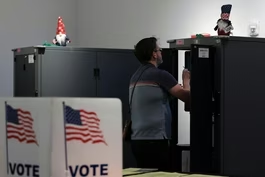 New
NewDemocratic and GOP strategists on Trump's unpopularity
Video has Closed Captions
Democratic and GOP strategists on how Trump's unpopularity is shaping the midterms (7m 25s)
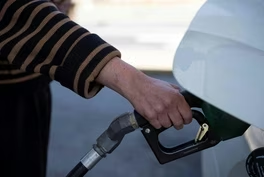 New
NewEconomist on inflation report, what's driving prices higher
Video has Closed Captions
Economist breaks down new inflation report and what's driving prices higher (4m 57s)
 New
NewFraternity culture under scrutiny in wake of Cornell case
Video has Closed Captions
FRATEFraternity culture under scrutiny in wake of Cornell allegationsRNITIES ON CAMPUS (9m 6s)
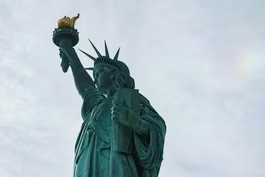 New
NewHow immigration policies shaped America and have evolved
Video has Closed Captions
How immigration policies shaped America and evolved throughout its history (11m 13s)
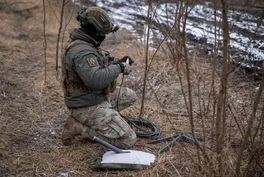 New
NewHow Starlink disruptions affected Ukraine’s war operations
Video has Closed Captions
How Starlink disruptions affected Ukraine’s battlefield operations (8m 16s)
 New
NewNews Wrap: Ship sinks after hitting Strait of Hormuz mine
Video has Closed Captions
News Wrap: Iran says cargo ship sank after hitting a mine in Strait of Hormuz (4m 41s)
Providing Support for PBS.org
Learn Moreabout PBS online sponsorship New Episode
- News and Public Affairs

FRONTLINE is investigative journalism that questions, explains and changes our world.
 New Episode
- News and Public Affairs

Today's top journalists discuss Washington's current political events and public affairs.
 New Episode
 New Episode
 New Episode
 New Episode
 New Episode
 New Episode
 New Episode
Support for PBS provided by:
Major corporate funding for the PBS News Hour is provided by BDO, BNSF, Consumer Cellular, American Cruise Lines, and Raymond James. Funding for the PBS NewsHour Weekend is provided by...