
Trump alienates America’s allies
Clip: 1/23/2026 | 21m 15sVideo has Closed Captions
Trump alienates America’s allies
Donald Trump goes to war, rhetorically, with America’s next-door neighbor and largest trading partner. The panel discusses his rift with Canadian Prime Minister Mark Carney and other American allies.
Problems playing video? | Closed Captioning Feedback
Problems playing video? | Closed Captioning Feedback
Major funding for “Washington Week with The Atlantic” is provided by Consumer Cellular, Otsuka, Kaiser Permanente, the Yuen Foundation, and the Corporation for Public Broadcasting.
Trump alienates America’s allies
Clip: 1/23/2026 | 21m 15sVideo has Closed Captions
Donald Trump goes to war, rhetorically, with America’s next-door neighbor and largest trading partner. The panel discusses his rift with Canadian Prime Minister Mark Carney and other American allies.
Problems playing video? | Closed Captioning Feedback
How to Watch Washington Week with The Atlantic
Washington Week with The Atlantic is available to stream on pbs.org and the free PBS App, available on iPhone, Apple TV, Android TV, Android smartphones, Amazon Fire TV, Amazon Fire Tablet, Roku, Samsung Smart TV, and Vizio.
Buy Now
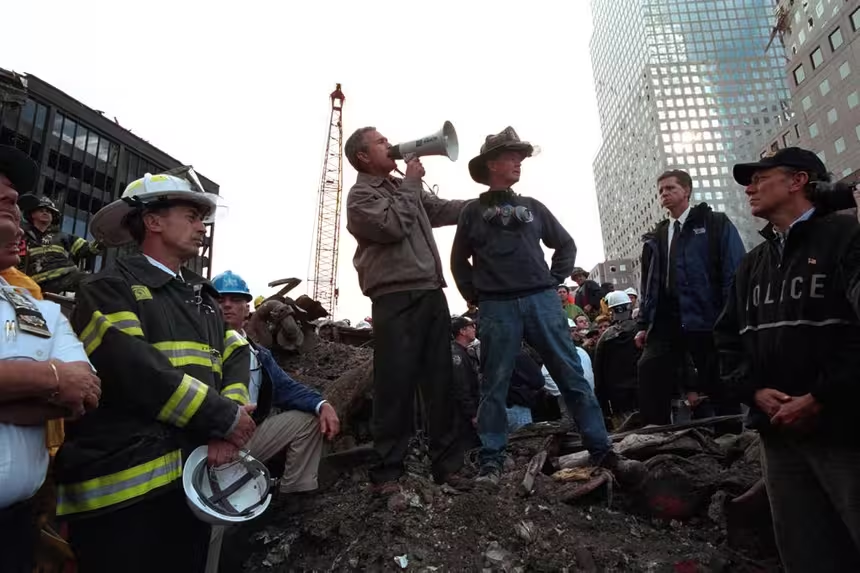
10 big stories Washington Week covered
Washington Week came on the air February 23, 1967. In the 50 years that followed, we covered a lot of history-making events. Read up on 10 of the biggest stories Washington Week covered in its first 50 years.Providing Support for PBS.org
Learn Moreabout PBS online sponsorshipLet's acknowledge that Donald Trump's blunt attempts to get European nations to spend more on their own defense is good for Europe, good for America, and good for us taxpayers.
Let's also state the obvious.
If you are interested in preserving Canada's independence and the independence of the free nations of Europe.
You would build your militaries the way America has built its military, but there are ways that allies talk to each other even when they disagree, and Donald Trump's way is not the usual way these things are done.
For instance, his offensive comments about NATO's contribution to the war effort in Afghanistan in which more than 1000 European soldiers died.
Do nothing except alienate America's friends.
And by the way, insult the American and European soldiers who fought side by side in countless battles over many years.
The question is, how much damage is he doing?
Joining me to discuss all this, Peter Baker, the chief White House correspondent at The New York Times.
Leanne Caldwell is the chief Washington correspondent at Puck.
Stephen Hayes is the editor of the Dispatch, and Idriss Calloun is a staff writer at The Atlantic.
Thank you all for being here.
I know that myself, I would rather talk about the snowstorm that's coming, but we're going to talk about the state of the world instead, because I don't have the weather equipment behind me.
I just have an inaccurate picture of the White House still.
Um, the, um, I just, let me start, let me start with you, but before we, before I ask you anything, I want you to listen to a little bit of what the Canadian Prime Minister said at Davos.
Let's listen to that.
If great powers abandon even the pretense of rules and values for the unhindered pursuit of their power and interests, the gains from transactionalism will become harder to replicate.
Hegemons cannot continually monetize their relationships.
OK, you're an economics reporter.
Ken Hegemon's continually monetize their relationship.
Answer that one second.
The first question is, what does this mean?
Everybody is talking about Carney's speech in which he talked about a rupture in the Western alliance as a rupture itself.
This is the moment when everything kind of burst out.
It was called a galvanizing moment at Davos.
We can make jokes about that later, but, but give us the context and give us the the the the importance of that moment.
I think what Carney did was he, he took the mask off.
He, he, one of the most important things that he said in that speech was that the rules-based International order hadn't really worked as intended, but Canada went along with it, that they knew that America sort of didn't abide by the rules all the time, but they, they adhere to it large and largely enough that that it was worthwhile for middle income countries to go along with rules, and now what Carney has said in both in this speech and in his trip to China when he met with Xi Jinping is that there's a new world order, um, and if Donald Trump wants to act like the hedgeman in North America, China in in uh Asia, Russia, and Europe, then countries like his have to pivot, and they have to deal with the multipolar world as it exists.
Um, and he, he had, he had a lot of good, good lines for economists, you know, compli complementarity or positive sum.
He's a central banker.
Central bankers seem to be the only people who are really good at standing up to Donald Trump in this country and in Canada.
That's interesting.
We're waiting to see what the Mexican central bank advisor, Peter, Trump was surprised and upset a little about this.
Actually there's an interesting, um, we have a little montage to show you about their very unusual kind of slow motion interaction.
Why don't we watch that for a second?
I want you to talk about it.
We are in the midst of a rupture, not a transition.
I want your Prime Minister yesterday, he wasn't so grateful that they should be grateful to us, Canada, Canada lives because of the United States.
Remember that, Mark, the next time you make your statements, but Canada doesn't live because of the United States.
Canada thrives because we are Canadian.
Now there was a certain, you know, nice bottle of maple syrup you got there, Mark.
Hate to see anything happen to it.
Quality to Donald Trump's laconic but threatening posture.
But what does, what does this out and out rupture mean for the relationship?
I mean, they're our biggest trading partner, among other things, and we share the longest border in the world, peaceful border in the world.
Where are we in the USC Canada relations?
Well, if Donald Trump gets his way, there will be no border.
It'll be in another part of the United States, and he demonstrated that online with a map that he shows in an artificial intelligence created image of US flag over the US over what's currently Canada, over what is currently Greenland, over what is currently Venezuela, as if to demonstrate that he intends to be the imperial power of the Western Hemisphere, and you can see why Canada might not take that as much of a joke.
It's not very funny to them And Carney, I think, you know, it's point is pulled off the mask is a good way to put it.
I think this is the week when our allies discovered that, that um flattery and uh you know, appeasement only goes so far, right?
Why did Donald Trump reverse course on Greenland.
It's very likely that he reverses course because he saw that it wasn't going to happen, right?
For the first time maybe in his 5 years in the White House, Europe and Canada and all these countries said no, no, that's not happening.
That's a red line here.
We're not going to try to pretend that this is a reasonable rational policy of trying to take over an ally's territory, and he and that had effect on the bond markets and ultimately he went from within a few hours saying I must have it all to, hey, you know, we'll see what happens.
let's go back in time.
A full week ago to when we were going to conquer Greenland, not Canada.
And by the way, remember Venezuela?
That was crazy.
Um, and remember Epstein before Venezuela?
That was also very interesting.
Uh, but go back to Greenland.
um is the crisis diffused, Steve?
I mean, I mean, he's so mercurial that it might just come pop back out next week.
Right?
I mean, look, he had said as recently as Wednesday, that he, the United States needed to control Greenland and the the strong implication was that we needed to take it.
However, he very deliberately did not rule out the use of force, and multiple times suggested that we would be using force to take it because we needed it.
Of course, Greenland was not mentioned in the 33 page national security strategy of the United States, but Trump threatened tariffs on allies on the, the supposition that not having Greenland constituted a national security emergency.
I mean we haven't had Greenland for centuries, but not having Greenland now constituted a national security urgency.
I mean, look, his arguments about Greenland have been farcical.
I think for a long time, and people have understood them as farcical until such point as they can't afford to.
They don't, Europeans and our allies and Canadian s they can't afford to have the seriously literally debate that people here in the United States does.
They have to take him seriously and literally, and they did, you know, it's interesting you mentioned that because Mike Johnson said this week that, you know, we take him, you should take him seriously but not always literally.
This was in the course of explaining, you know, that he understands why what Trump wants Greenland, but you know, we're not going to have a war and Leeanne I always, I, I, I always ask you the same question.
It's really groundhog Day, but when when, when are they going to in Congress, going to say, uh, no, like stop doing this.
There's literally no it's very hard to find a positive reason to alienate Canada.
Like, and there are a lot of Republican senators who understand that.
Give us a sense inside the Senate Republican caucus, just for starters, and you can go to Mike Johnson.
Give us a sense of are you seeing any, to borrow a word from Canada, ruptures.
Yeah, well, you get sick of asking me the question.
I kind of write this different version of the same thing all the time, but I will say with the Greenland situation, um, when I was talking to Republicans on Capitol Hill.
This is really the first time in the second Trump administration that I I got a lot of anger privately, of course, from House Republicans.
This was a red line for them as any sort of military invasion if Denmark came with open arms and said, name your price.
Yes, that is a whole different story.
um, but, uh, there was a lot of backchanneling with the administration to let them know that not only is this not going that that it's not going to be approved.
Congress isn't going to support it.
that he is actually hurting their midterm chances this is something that is absolutely unpopular with voters who are like why are we talking about it?
Um, but they were afraid to say anything publicly.
They didn't want to poke the bear.
You need to know, right?
And that's the answer, right, which, which means that they were hoping that this backchanneling and this subtle conversation with the president and his team would would get them to the right place.
Was it this back channeling or was it the market dip on the fear that Trump was about to go attack a treaty ally.
Idris.
I think I think it was the stock market going down.
I think it was 10 year or 30 year yields going up, mortgage rates are going to go up as a result of that.
It was also the Europeans saying very clearly for probably the first time that no, this will not stand you know, if you look at what's happened over the course of the last year, the Europeans accepted a pretty not nice trade deal.
They basically accepted that America would be tariffing their goods, and they weren't going to retaliate, and they, I think I've seen the limits of appeasement.
I think that that that channel was probably very important.
Um, I think the Republican pushback, you know, it's been, it's been real.
That's how a lot of the nominees have gotten pulled.
They don't don't sort of get pulled with a public denunciation but this private backchannel.
You do see that and it does exist, but you know, if it's the president and he really, really wants to do it, ultimately I think the Republicans in Congress cave.
That's at least what's happened.
Well, listen to this.
Listen to this statement made by Senator Eric Schmidt of Missouri, um, who was a stalwart Trump supporter.
He said, about Greenland.
Europe can't protect it.
The Danes can't protect it.
That's just an obvious fact at this point.
And so it is in the strategic interests of the United States of America to pursue this.
How many people believe that who say it and you know, it, it's hard to know what's in people's hearts, but you have people literally a year ago if you went to every senator and said name the top 100 issues facing the United States.
Literally nobody would put Greenland on the top 100.
No, no, it's people like Eric Schmidt.
It's people like, you know, Bernie Marino.
It's uh um Ted Cruz, Ted Cruz, um, yeah, so there's a, there's a group of them who will do anything that the president says, and it will be OK.
They think that what he says is great and and gospel, you know, but there is a very slim majority in the House of Representatives.
The House has been it's down to like 218 to 214.
Yeah, there's a two seat majority right now, and you know the House has been more in lockstep as a whole than the Senate, but you know, Don Bacon, of course he's retiring.
He's one of the few that speaks up, but he said he told me, he said, look, invading an ally who we have a treaty with is a high crime and misdemeanor.
Um, and so he said that he has talked to other Republicans about impeachment if that were to be the case, you know, all of this is bluster right now, um, but it really did rattle.
um members that this was the path that they were worried that he was just crazy enough to go down.
So the interesting thing, Peter, is that is that he does seem, the president does seem somewhat sensitive to the bridge too far aspect of this.
Is that fair?
Well, look, there are a number of instances in the last few weeks we've seen him go out there and make extravagant threats and then to back off, right?
He said he was sending the army or the military or the National Guard in Minneapolis, and then JD Vance said this week, well, we don't really need to invoke the Insurrection Act.
It's going to be OK.
He said that he was going to bomb Iran.
right?
If they killed protesters.
Well, they killed protesters.
They killed thousands of protesters.
He did not bomb Iran.
I'm not saying he should or shouldn't have.
I'm just saying that he said he would and then he didn't.
Similarly, on Greenland, he was going to tariff Europe.
He might use military force.
Suddenly he backs off, and I think it's lending itself to this feeling that Leanne sort of alluded to here.
He used the word crazy.
There is this feeling in Washington among Republicans as well as Democrats that, you know, is he off the rails here and it's hard to know when he is because he seems always to be erra tic and mercurial and volatile, but is there a point where it's going so far that you have a guy in the White House, ultimate power because he seized it.
Um, all over the place.
Yeah, it'd be weird.
It would be weird if Republicans suddenly discovered that the guy who lied about an election and instigated a soft coup was too crazy to conduct, but I think this has been an interesting week in the sense that, oh, like, don't mess with Greenland turns out to be the closest thing, but I don't think I don't agree with that.
I mean, I we got some of the same reactions that Leanne got in talking to people on Capitol Hill as well, but like, that's a clarifying moment.
You're talking about invading a NATO territory of a NATO ally.
They're declaring it a red line.
They're really angry privately, but they won't say it public and come on.
That's not backbone only thing that has much more to do with these other external factors that he's responding to.
I mean, he has to just assume at this point that Republicans are going to support him regardless of what he does no matter how crazy it is.
Leanne, you were going to say, yeah, I was just going to say the public, the public justification among Republicans was, look, this is just Donald Trump.
This is bluster.
This is a negotiating tactic, and that is what they hid behind, and you know, you're right, it's Congress has dispelled most of its authority and power given it away to this administration over and over again.
Speaker Mike Johnson has led that and allowed that.
There is some rank and file frustration among Republicans over that fact too, but um they aren't going to do anything about it, it seems, I mean, Idris, I want to ask you this because we have you and and you're an expert.
It's the sort of question that um I wouldn't even imagine asking a year ago.
Uh, but what, what would be the long-term consequences of a semi-permanent hostility between Canada and the United States economically.
for starters.
I mean, they're massive trading partners with each other, um, so it would hurt the Canadians more because they're more dependent on us than we are on them, but it would hurt us as well.
I mean, the fact that Carney took away the tariffs on Chinese electric vehicles, gives avenue for those vehicles to get into America, cause a lot of vehicles travel up and down the border, but there are all sorts of consequences as well for this rupture between between the two, the fact that you have a our closest trading partner now triangulating, coordinating with China, Qatar, other, other countries like that, that's not a situation that America wanted to be in, um, you know, it is going to in the pursuit of uh maintaining kind of hemispheric control and asserting rights over Greenland and Venezuela.
It's going to lose a lot from probably it's most important ally in in North America, and that, that's um that that's quite something.
I mean, the fact that Mark Carney would even say things like this.
I mean, that's, I think, why so many the reception of his speech was so was so potent, um, that he called out also his European counterparts in saying that you've gone too far in accommodating this.
You have to sta stand up and Trump will Trump stopped saying the 501st state thing after Carney took over.
He didn't respect Trudeau, and he kept saying it.
Now that Carney came he went to the White House, he showed a bit of spine.
Trump backed off, and I think that Carney knows that.
I mean, we're actually seeing something that is very seldom seen in nature, an angry Canadian, right?
We don't know the, the, the, the true latent power, right?
It's, it's, it's, it's fascinating to watch.
Steve, step back and talk about America's alliances in Europe first, you know, so on a scale of 1 to 10, 1 being Churchill and FDR and 10 being we're in we're militarily invading Greenland.
Where are we in the in the health of the post-World War II European order.
I mean, 9.5?
You think it's that bad.
Yeah, look, do you remember that's bad.
Remember January of 2003, Donald Rumsfeld made an offhand remark in which he referred to France and Germany as old Europe.
That created weeks-long diplomatic row that threatened the diplomacy on the lead up to the Iraq War.
There was so much chin stroking and European anger about that.
And now Donald Trump is just shrugging off the deaths of soldiers, of allied soldiers.
In the wars that we asked them to fight with us.
He's belittling their leaders again and again and again.
He's forcing them to take steps that require them to go beyond just thinking about sort of theoretically what the relationship with the United States is to making alternative plans, and that's what that's what we saw this week is this is no longer theoretical.
They're not waiting around.
They're creating additional alliances.
They're going elsewhere.
Peter, I'm not gonna let the statement that he made about NATO troops go by without extensive comment.
Um, I mean you've seen it, we've all seen it, we should take another look at it because it's quite extraordinary.
It ranks up there with the, to me, in, in my mind, it ranks up there in the uh norm-breaking power of his comments 10 years ago about John McCain's war record.
You just listen again to this.
I'm sure you've all heard it.
They'll say they sent some troops to Afghanistan or this or that, and they did, they stayed a little back, a little off the front lines, but uh we, uh, we've been very good to Europe and to many other countries.
Yeah, uh, it's worth remembering that the NATO alliance is a mutual defense pact.
It's not an offensive line, it's a defensive alliance.
And the only time in its history Article 5, which is the article that says attack on one is attack on all.
was ever invoked was on our behalf after 9/11, NATO said, We are on your side.
We are with you.
You have been attacked.
You are our ally.
We are with you.
They've they've never invoked it.
We've never actually had to go on, had to go to them in a combat situation when they were attacked.
They came to our assistance after 9/11.
Now, look, you know, they were not uh the main forces in Afghanistan and Iraq, sure, but proportionately for countries like Denmark, more than 1000 troops, yeah, a lot of troops died, and when, and, and when, and they didn't have to, they didn't have to come.
They did.
They came because America is their friend, and, and they came in a proportion to some of these smaller countries like Denmark that may not be a lot for America, but for Denmark, a lot of people died and and and and it had lived large in their politics because they didn't, you know, they had the leadership had to defend these decisions against a public that wasn't necessarily sure it wanted to be there.
Another line in Trump's speech that I thought was even more shocking than that was when he was talking about NATO and he said we would be, we will be there for them, but I'm not sure if they'll be here for us, and that literally an inversion of what Peter just described, and you know there's a bipartisan congressional Code, of course, the bipartisan members were Lisa Murkowski and Tom Tillis, the two Republicans who are willing to stand up against the president sometimes, um, and on their Codell over the weekend to Denmark.
They visited the memorial where the Danish soldiers died in Iraq and Afghanistan and so it was just counter that statement was absolutely the opposite of what has actually happened.
Let's remember, by the way, what has Trump actually said about Article 5 defending Europe.
He said during the campaign, if these guys don't pay up, Russia, do whatever the hell you want for them.
His line, not mine.
Russia, do whatever the hell you want with it.
So Article 5, he has made clear is to him, you know, conditional.
and not actually an absolute commitment by the United States to its allies that it had for the last 75, 80 years
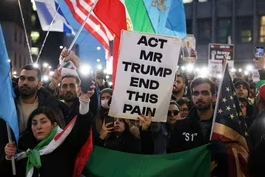
Will Trump attack Iran in 2026?
Video has Closed Captions
Clip: 1/23/2026 | 2m 32s | Will Trump attack Iran in 2026? (2m 32s)
Providing Support for PBS.org
Learn Moreabout PBS online sponsorship
- News and Public Affairs

Top journalists deliver compelling original analysis of the hour's headlines.

- News and Public Affairs

FRONTLINE is investigative journalism that questions, explains and changes our world.











Support for PBS provided by:
Major funding for “Washington Week with The Atlantic” is provided by Consumer Cellular, Otsuka, Kaiser Permanente, the Yuen Foundation, and the Corporation for Public Broadcasting.