
The Statue of Liberty
For more than 100 years, the Statue of Liberty has been a symbol of hope and refuge
From
The Statue of Liberty
10/28/1985 | 1h 1m 13sVideo has Closed Captions
For more than 100 years, the Statue of Liberty has been a symbol of hope and refuge
For more than 100 years, the Statue of Liberty has been a symbol of hope and refuge for generations of immigrants. In this compelling and provocative portrait of the statue, Ken Burns explores both the history of America’s premier symbol and the meaning of liberty itself. Featuring archival photographs, readings from diaries, letters and newspapers of the day the story of the monument is told
From
Problems playing video? | Closed Captioning Feedback
Problems playing video? | Closed Captioning Feedback
Funding Provided by: General Motors Corporation, the Corporation for Public Broadcasting, PBS, Liberty Mutual Insurance Company and the Henry Nias Foundation.
The Statue of Liberty
10/28/1985 | 1h 1m 13sVideo has Closed Captions
For more than 100 years, the Statue of Liberty has been a symbol of hope and refuge for generations of immigrants. In this compelling and provocative portrait of the statue, Ken Burns explores both the history of America’s premier symbol and the meaning of liberty itself. Featuring archival photographs, readings from diaries, letters and newspapers of the day the story of the monument is told
From
Problems playing video? | Closed Captioning Feedback
Where to Watch The Statue of Liberty
The Statue of Liberty is available to stream on pbs.org and the PBS app.
Buy Now
Providing Support for PBS.org
Learn Moreabout PBS online sponsorshipANNOUNCER: Original production funding for "The Statue of Liberty" was provided by Liberty Mutual Insurance Company.
Funding for the digital restoration of the film was provided by the Better Angels Society.
Supporting excellence in American history documentaries.
JEFFERSON: Listen.
We hold these truths to be self-evident: that all men are created equal, that they are endowed by their Creator with certain unalienable rights, that among these are life, liberty, and the pursuit of happiness.
Thomas Jefferson.
("American Tune" by Paul Simon).
♪ SIMON: Many's the time I've been mistaken.
♪ ♪ And many times confused.
♪ ♪ Yes, and I've often felt forsaken.
♪ ♪ And certainly misused.
♪ ♪ Oh, but I'm all right, I'm all right.
♪ ♪ I'm just weary to my bones.
♪ ♪ Still, you don't expect to be bright and bon vivant.
♪ ♪ So far away from home, ♪ ♪ So far away from home.
♪ ♪ I don't know a soul who's not been battered.
♪ ♪ I don't have a friend who feels at ease.
♪ ♪ I don't know a dream that's not been shattered.
♪ ♪ Or driven to its knees.
♪ ♪ Oh, but it's all right, it's all right.
♪ ♪ For we lived so well so long.
♪ ♪ Still, when I think of the road we're traveling on.
♪ ♪ I wonder what's gone wrong.
♪ ♪ I can't help it, I wonder what's gone wrong.
♪ McCULLOUGH: The Statue's only a symbol.
The Statue is only copper and granite and steel, iron.
It's what it speaks to us about, what it makes us feel inside that's so important.
We are all the beneficiaries of those who've gone before us, who've worked, who have fought on occasion, who have cared immensely to the very depth of their soul to achieve liberty.
If we really want to know her, the beginning should be the question: What is liberty?
FORMAN: Liberty is the most civilized and least of evils in the world.
JORDAN: Liberty is the absence of constraints and barriers and impediments.
KOSINSKI: It's freedom to be oneself, to do what one wants to do, to remain oneself for as long as one chooses to, and basically that's all.
It's not happiness; it's not responsibility; it's not truth; it's just being oneself.
FORCHE: Well, liberty is the old French word that we have begun in English to equate with freedom.
BALDWIN: What is liberty?
Oh, wow.
That's quite a question.
But I suppose almost nobody really asks themself that question.
Well, I can always quote the Declaration, “We hold these truths to be self-evident.
All men are created equal."
And the moment I do that, I'm in trouble again because... Obviously I was not included in that pronouncement.
“That they are endowed by their Creator with certain unalienable rights, that among these rights are life, liberty and the pursuit of happiness.” Ah, what is liberty?
BARTHOLDI: Colossal statuary does not consist simply in making an enormous statue.
It ought to produce an emotion in the breast of the spectator, not because of its volume, but because its size is in keeping with the idea that it interprets and with the place which it ought to occupy.
Fredrick Auguste Bartholdi REPORTER: Daily News, London, July the 3rd.
It towers to the skies from the factory yard of the rue de Chazelles.
The view from its coronet sweeps clear of the six-story houses and right beyond the walls of Paris.
NARRATOR: In the autumn of 1875 on a quiet residential street in Paris where nothing much had ever happened, work began on a statue unlike any ever built before.
It would be a gift from the people of France to the people of the United States.
And it would celebrate an ideal: Liberty.
When completed, she would be the tallest structure in the New World, her torch stretching 305 feet above the harbor, taller even than the recently completed Brooklyn Bridge.
She was hand-built by Frenchmen in Paris.
Italian immigrant stone masons laid her foundation in New York.
And hundreds of thousands of French and Americans, ordinary people mostly, paid for her construction.
But she was primarily the creation of one driven man, Fredrick Auguste Bartholdi, a man who wasn't even sure he liked Americans.
REPORTER: Monsieur Bartholdi has conceived this celebration of American independence, applying to it a sublime phrase which sums up the progress of modern times: Liberty Enlightening the World.
He has chosen to represent this great idea by a statue of colossal proportions which will surpass all that have ever existed since the most ancient times.
NARRATOR: But the idea for the Statue of Liberty was not Bartholdi's.
It was born over brandy and cigars in a country home near Paris one evening in 1865.
The host was Edouard de Laboulaye, historian, professor of law, chairman of the French Anti-slavery Society.
The talk was of liberty, then in trouble in France, curtailed by the tyranny of Emperor Napoleon the Third and menaced by the revolutionary chaos that seemed the likely alternative.
Laboulaye believed passionately that democracy was the future and America its shining example.
And so, very shrewdly, he proposed a huge monument to celebrate liberty as America was about to celebrate its 100th birthday.
FrFrance to restore liberty at home.
No one who was gathered that evening at Professor Laboulaye's was more interested that Bartholdi, "So deeply interested," he wrote, "That the idea remained fixed in my memory."
BARTHOLDI: I will try to glorify the republic and liberty over there in the hope that someday I will find it again here in France, if it can be done.
Bartholdi.
NARRATOR: He was born in the medieval city of Colmar in Alsace to a family of comfortable means.
He started out as a painter, turned to sculpture which allowed work on a bigger scale.
At age 21, he created a Napoleonic general, so tall at 26 feet that it couldn't fit into the exhibition hall for which it was intended.
It made him famous all over France.
CRITIC: Bartholdi is an Alsacian as well as a Frenchman, still young for an artist of his reputation.
He gives you the impression of a man of power and his works confirm it.
He loves to model on a colossal scale, perhaps because this most readily conduces to the simplicity and massiveness of effect which he seeks in art.
He is a sculptor of the old and, as most of us still think, the best school.
NARRATOR: He traveled to Egypt for the opening of the French-built Suez Canal.
He wanted to build a mammoth monument at its entrance, a light house in the form of an Egyptian woman bearing a torch.
He presented his plan to the ruler of Egypt, gave it the grand title of "Progress" or "Egypt Carrying the Light to Asia."
He was turned down, but only momentarily discouraged and he carefully saved his drawings.
In 1871 Laboulaye urged Bartholdi to visit America.
And on June 21st, Bartholdi sailed for the first time through the Verrazano Narrows into New York Harbor.
He never forgot the moment.
BARTHOLDI: It is exactly here that may statue should be erected.
Here where people have their first view of the New World.
I have f It is Bedloe's Island just opposite the Narrows which are, so to speak, the gateway of America.
NARRATOR: His "admirable spot" had once sheltered a pest house, a gallows, a paupers' grave and was now an abandoned fort.
But Bartholdi was certain he had found the site for his masterpiece.
From New York he traveled across America, never missing an opportunity to promote his dream.
The size of the country impressed him.
He marveled at the immensity of Niagara Falls and Yosemite, Monument Valley and the giant sequoias.
"Everything is big here," he told his mother, "Even the peas."
BARTHOLDI: All these things are of the greatest interest.
What is lacking in the cities and most of the men, however, is charm and taste.
NARRATOR: In 1875 a new and moderate republic had been established in France.
Paris was once again the cultural capitol of Europe, some said the world.
For Laboulaye and Bartholdi the time was perfect to bring their idea to the French people.
They formed a French-American Union.
And to raise money launched a nation wide lottery.
In all, 181 municipalities, 40 general councils, 10 chambers of commerce and 100,000 individual subscribers contributed the 600,000 francs Bartholdi thought he would need.
BARTHOLDI: She will not resemble those bronze colossi so venerated, of which it is proudly declared that they have been cast from cannons taken from the enemy.
Our statue will be made of pure copper and be the product of labor and of peace.
NARRATOR: Bit by bit Bartholdi evolved the form of his statue, borrowing generously.
A woman in robes bearing the light of reason had stood for liberty since classical times.
It was rumored all over France that the statue was modeled after the face of Bartholdi's mother and the body of his mistress.
And there was still another influence, the Freemasons, a secret international brotherhood linked to the ancient builders of the pyramids and the cathedrals.
Freemasons were devoted to peace, to liberty and enlightenment.
George Washington was a Freemason.
So were Jefferson and Franklin and countless others who made America.
Freemasons designed the dollar bill.
Freemasons planned the Washington Monument, an obelisk symbolizing the ray shining from God to enlighten mankind.
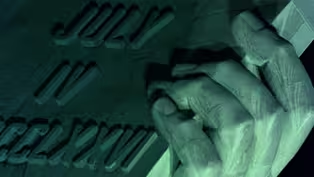
And Masonic symbols were to be present in the Statue of Liberty as well: a torch, the light of human intellect; a book, the laws of the Supreme Architect, indelibly inscribed with the date of America's independence.
Bartholdi himself became a Freemason as he began construction.
CRITIC: Daily News, London.
The workshop was built wholly and solely for the accommodation of this one inmate and her attendants, some fifty workmen hammering for their lives on sheer copper to complete her tresses.
NARRATOR: Now in the workshop of Gaget and Gauthier at 25 rue de Chazelles work began in earnest.
Bartholdi drove himself hard, supervising every aspect of the work.
He built three successively larger models, the last a quarter of the final size.
Each enlargement required more than 9,000 measurements taken painstakingly from plumb lines and then multiplied accordingly over and over again.
Finally a full size model was built in pieces made of wooden lathe, these first roughly covered with plaster, then carefully carved in full detail.
Craftsmen spent weeks working on fingers, toes and eyebrows.
BARTHOLDI: May 13th, 1876.
A worker who is applying and smoothing clay looks like a pygmy in relation to one of the fingers.
CRITIC: Daily News, London.
The farther the coppersmiths advanced with their task, the more Lilliputian they became in relation to it.
What were men, for instance, or the children of men in that awful eye?
CITIZEN: The Bartholdi statue must be modeled after some Ohio girl, the ears are three feet long.
NARRATOR: Once the plaster carving was finished, a wooden negative was built, a honeycomb conforming exactly to the pieces of the model.
In another corner of the shop men took big sheets of copper about the thickness of a silver dollar and hammered them into the honeycomb until they had precisely the same shape and contour as the plaster original.
By the time they were finished, 300 copper sections were ready for assembly.
Bartholdi finished the right arm and torch first so they could be displayed at the American Centennial Exhibition in Philadelphia.
Though the Statue was to be a gift from France, Americans were expected to provide the place for her to stand.
But Bartholdi had no guarantee the Americans would come through.
There had been complaints about the Statue all along.
CRITIC: "It would unquestionably be impolite to look a gift statue in the mouth, but inasmuch as no mouth has yet been cast of the bronze Liberty we may be permitted to suggest that when a nation promises to give another nation a colossal bronze woman, and after having given one arm, calmly advises the recipient of that useless gift to supply the rest of the woman at its own expense, there is a disproportion between the promise and its fulfillment which may be forgiven but which cannot be wholly ignored."
New York Times.
NARRATOR: Some Americans distrusted the French whom they believed radical or effete, even immoral.
Clergymen worried about a pagan goddess on American soil.
An art critic scoffed that the Statue would look like "A bag of potatoes with a stick projecting from it."
CITIZEN: Of course the female arm had its uses but it is only of secondary importance.
A woman without arms might be of some considerable value but arms without any accompanying woman would be utterly valueless.
NARRATOR: When New Yorkers seemed less than enthusiastic about the gift, Bartholdi hinted he would be just as happy to have his statue stand in Philadelphia.
But Bartholdi had no intention of setting the statue he now called "my American" anywhere but in New York Harbor.
BARTHOLDI: If there is any place on earth that needs light, it is certainly New York.
NARRATOR: The arm and the torch were eventually returned to Paris, but there was a problem.
Bartholdi wasn't exactly sure how to hold all the pieces together.
The more than forty foot span of her shoulders high above the tides and squarely into the wind would create a sail as big as on any ship.
And how would a structure so enormous actually be built, transported across an ocean, and kept stable on its pedestal?
A new man was enlisted, one of the greatest engineers of the century, Alexander Gustave Eiffel.
Already celebrated throughout France for his daring bridges, Eiffel would later create the world's most famous tower.
He spent a year devising a sturdy but elastic framework that would not only carry the eighty ton copper skin but be heat, cold and storm proof.
Now in the courtyard of Gaget and Gauthier, Eiffel began building his statue.
It was a sturdy pylon made of cross-braced iron posts 96 feet high and this supported a framework of light beams, a forerunner of the skyscraper.
Most ingenious of all were the hundreds of short thin iron bars fitted to the framework which would attach directly to the inside of the copper skin.
They would act like springs, allowing the statue to sway, expand and contact and breathe.
Each copper piece would be separately riveted to the frame, thus no one piece would carry the weight of any other.
When Eiffel's pylon was finished, workers began wrapping it in copper.
Bartholdi, ever the promoter, held a lunch in the leg to introduce Eiffel to the press and to keep his structure front page news.
CRITIC: The New York Herald, April 5, 1884.
"The entry is by the sole of the uplifted foot, fairly spacious doorway.
It is rather dark inside but the gloom is pierced by thousands of little eyelets of light marking the holes left for the rivets.
From the gallery of the torch, all the glory of Paris bursts on the view, miles and miles of house roofs, all as even as if they had been mown like grass with a scythe."
NARRATOR: She was proclaimed a modern cathedral.
The Freemasons were delighted.
Jules Grevy, the president of the French republic, came to see her.
So did Victor Hugo, the venerable poet of French democracy, 82 years old and only months from death, but determined to see for himself this huge testament to the ideals for which he had struggled all his life.
He stood silently for a long time, staring first at the Statue, then at Bartholdi.
Finally he spoke.
"The idea," he said, "it is everything."
On July 4, 1884 she was formally handed over to the minister of the United States, Levi P. Morton.
She was at last what Bartholdi had called her: "My American."
In New York, though no one had figured out how to pay for it, the pedestal was under way.
The designer was America's most fashionable architect, Richard Morris Hunt.
During 1882 and '83 he sketched out innumerable designs, toying with pyramids and ziggurats and other less exotic styles.
Corresponding frequently with Bartholdi, although each man heartily disliked the other, Hunt arrived at last at the final form.
It was a solid monument of classical and Egyptian features that took into account the contours of the abandoned fort.
Almost as tall as Liberty herself, Hunt's pedestal would complement Bartholdi's statue but not compete with it... If, that is, someone could come up with the money.
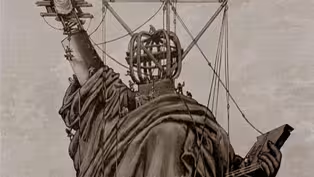
Back in Paris workers dismantled the Statue and packed her in 210 crates... 36 just for nuts, bolts and rivets, and put her aboard the sleek white warship, Isere.
5 and very nearly didn't make it.
Halfway across, the Isere was struck by a storm.
For 72 hours sheght as her huge, wildly shifting cargo threatened to capsize her.
Nearly 100 ships greeted the battered Isere on her arrival in New York Harbor.
But it was still not certain the dismantled statue would ever be reassembled.
AMERICAN: It is ridiculous for Frenchmen to continue to impose on Americans a present they refuse to accept, to worry them with a souvenir that offends them, to humiliate them with a generous idea they do not comprehend, and to beg for thanks that they will not give.
BARTHOLDI: The greatest difficulty, I believe, will be the American character, which is hardly open to things of the imagination.
CRITIC: Bartholdi is said to be so mad about the wrangles over the pedestal of his statue that he has serious thoughts of remodeling part of his own work so that Liberty may appear in the attitude of applying her thumb to her nose and twiddling her fingers.
NARRATOR: As the Isere began to unload her precious cargo, work on the pedestal stopped.
The money had run out.
REPORTER: This torch and arm ought to be extended as if asking for alms instead of triumphantly raised towards heaven.
PULITZER: It would be an irrevocable disgrace for the city of New York and the American republic to see France send us this splendid gift without our having furnished simply a place to put it.
There is only one thing to do.
We must collect money.
Joseph Pulitzer.
NARRATOR: Joseph Pulitzer, a Hungarian immigrant, was the new publisher of an old newspaper, "The New York World."
He was a strange, brilliant man, half blind and almost wholly neurotic.
A self-styled champion of the ordinary people of his city, he could not abide the noise they made lining the walls of his office with cork to shut it out and eventually running his paper from far out at sea on a yacht called "Liberty."
In 1885, he launched an attack on wealthy New Yorkers who would allow their city to be disgraced by not having provided a foundation for Liberty.
From that moment on, he promised he would publish the name of every man, woman, and child who contributed to the Statue, no matter how small their contribution.
PULITZER: 250,000 that the Statue has cost was paid out by the mass of French people, by workers, shopkeepers, salesgirls, craftsmen.
Let us not wait for the millionaires to give this money.
This isn't a gift from the French millionaires to American millionaires, but a gift of the whole French people to the whole American people.
Give something, no matter how little.
Let us hear from the people.
NARRATOR: He did hear.
Pulitzer and The World raised $120,000, much of it in contributions of a dollar or less.
STUDENT: We have taken three lessons in French and we don't like it, but we love the good French people for giving us the beautiful statue and we send you a dollar, the money we have saved to go to the circus with.
CONTRIBUTOR: Since leaving off smoking cigarettes, I have gained 25 pounds, so I cheerfully enclose a penny for each pound.
NARRATOR: Finally in the spring of 1886, workmen began prying open the wooden crates that had been sitting on Bedloe's Island for a year.
In just three months the Statue once again rose up around its skeleton, 21 years after the dinner at Professor Laboulaye's; fifteen years after Bartholdi first sailed through the Verrazano Narrows; ten years after the American Centennial celebration for which the Statue had originally been intended.
Three days before the official unveiling Bartholdi nervously surveyed his finished work.
BARTHOLDI: I was very anxious about the formation of some of the lines.
But it is a success.
I believe that it will last until eternity.
NARRATOR: October 28, 1886 dawned cool and cloudy and at ten in the morning a steady rain began to fall.
Nobody seemed to mind.
Enthusiastic crowds of more than a million lined the streets.
20,000 New Yorkers paraded down Broadway.
Early in the afternoon some 600 dignitaries were ferried out to Bedloe's Island for the great unveiling.
The general public was not invited and exactly two women were present for the ceremony honoring this giant statue of a woman, an irony not lost on a group of suffragists who circled the island in a chartered boat shouting their outrage through a megaphone.
But their words went largely unheard in the unceasing din.
The French flag hung over the Statue's face and Bartholdi himself, dressed in evening clothes, had climbed into the torch where he sat ready to pull the silken cord that would formally unveil his creation once President Grover Cleveland completed his formal remarks.
But somehow signals were misinterpreted, the sculptor gave a sharp pull before the President had even made it to the podium.
(fireworks exploding).
Newspapers on both sides of the Atlantic printed every word of every speech and all the songs and anthems.
"The Times of London," however, looked upon the proceedings with skepticism.
COLUMNIST: We question why liberty should be sent from France, which has too little, to America, which has too much.
NARRATOR: Nobody said a thing about welcoming immigrants.
(footsteps approaching) WELLS: On they go, from this pen to that, towards a little metal wicket, the gate of America.
Through this wicket drips the immigrant stream, all day long, every two or three seconds, an immigrant with a valise or bundle, into a new world.
H.G.
Wells.
1905 IMMIGRANT: Anyone who came through it, I mean, there was gates to go through... Once people passed by this here, they felt just like a newborn baby.
IMMIGRANT 2: I felt like the world opened up.
It was the most beautiful sight I have seen.
I felt like reaching for it and I thought maybe I was going to climb over it.
But it was the most gorgeous sight I have seen.
And since then I always look at the Statue and I feel that it's like a godsend country.
IMMIGRANT 3: Personally, I believe that the Statue of Liberty is supposed to be remembered by anyone who passed by the Statue of Liberty.
I mean, for people that came after that, they don't seem to realize how much tears and also how much laughter people lost or gained by going through the Statue of Liberty in those days.
FORCHE: I think more than any other American symbol it probably endures in the heart warmly as does the poem inscribed on the base of it.
I feel that perhaps it was an early symbol of our intention toward equality and a country made from a human community, built as a human community, a global community.
Not like the brazen giant of Greek fame.
With conquering limbs astride from land to land.
Here at our sea-washed, sunset gates shall stand a mighty woman with a torch, whose flame is the imprisoned lightning, and her name, Mother of Exiles.
From her beacon hand glows world-wide welcome.
Her mild eyes command the air-bridged harbor that twin cities frame.
“Keep, ancient lands, your storied pomp” cries she with silent lips.
“Give me your tired, your poor, your huddled masses yearning to breathe free.
The wretched refuse of your teeming shore, send these, the homeless, tempest-tost to me.
I lift my lamp beside the golden door!"
CUOMO: Symbols are important.
You send a Christmas card or a Chanukah card.
You go to a wake.
You embrace.
You kiss.
You touch.
Symbols are important.
And reminders of the essence of this country are very, very important because the further we get away from our essence, the deeper trouble we're in.
So it's good to have a great statue in the harbor that says, "This is why we came and let's not forget it."
GREGORIAN: Well, from childhood when I was in Tabriz, Iran, on the U.S.
stamps and everything was the Statue of Liberty and I had a very idealized notion of America, a land of freedom and everything you heard in the textbooks, I bought it as a child.
So that even though later years, I went to school and I learned about nuances, ambiguities, shades, and all kinds of shadows the Statue of Liberty had, the first day that I approached New York it was a shattering experience for me to find that a whole nation was welcoming me spiritually to a new land.
(Charlie Chaplin in "The Immigrant.")
♪ ♪ ♪ ♪ CUOMO: The way I described it was, "A fictional interview on Ellis Island of my mother," "What's your name?"
"Immaculato Giorsdano Cuomo."
"Where are you from?"
"Tremonte."
"How old are you?"
"Twenty-five."
"Do you have money with you?"
"No, maybe a few dollars."
"Are you educated?"
"No, not really."
"Do you have a skill, any job?"
"No."
"Where are you going?"
"To meet my husband."
"Where is he?"
"In New Jersey."
"Does he have a job?"
"No, but he makes iforse."
"What is that?"
"Trenches."
"Oh, he's a ditch-digger."
"Yes."
"Well, what do you have?"
"Well, we have nothing much except one child."
"You have no money, no skill, no friends, no job, your husband's a ditch-digger, you have one child.
What did you come here for?"
"Well, we came because over there was worse."
"And what do you expect of this country with the little you've brought us?"
"Oh, not much.
Just one thing: before I die, I'd like one of my sons to be Governor of the state of New York."
(“Anything Can Happen.”) PASSENGER: The Statue of Liberty!
IMMIGRANT: How are you?
(speaking in foreign language).
IMMIGRANT: Talk English.
I learn.
MAN: All right.
First thing you learn: to Statue of Liberty you don't say 'How are you?'
To people you say, 'How are you?'
To Statue you say, 'Is pretty.
Is beautiful.'
Not, 'How are you?'
FORMAN: My first reaction was very disappointing because she looked small from a distance, you know.
And then, she grew up in my eyes when I was standing there looking at her.
KOSINSKI: When I look back, I think she's been probably the only woman I have always been it love with from the age of twelve.
And for a long time I thought I would never meet her in person.
And when I arrived here I was 24.
That's probably the first trip I have made.
The first photograph of myself in New York was of myself in front of her.
There I was, finally joined with the object of what was actually long love.
McCULLOUGH: To me the Statue of Liberty is like the light that's left on at home.
If you're coming back on a passenger ship, coming back on a troop ship, coming home, there she is, saying you knew you were there, you'd taken the right boat.
And then you're right under it and you look up and you say “My God, my God.” And you feel something I think really much more than just being an American, you feel the importance of being human.
And you feel a kind of fraternal bondage with everybody who has come here.
TWIN: We came from Russia.
TWIN 2: We came from Kiev and then we went to... TWIN: Our mother died so we went to Italy, then we came here.
BLOCK: I come from Austria and I ended up in New Jersey.
(speaking Italian).
BIANCO: Oh, he knows.
Libertá.
Freedom.
(speaking Italian).
BIANCO: He says it's a nation that you can go out, you don't have to get scared.
It's a free country.
And it's different from Europe altogether.
You can say anything you want.
You can get home any time you want.
You don't have to get scared, you know, it's a different country altogether from Europe.
It's, liberty means freedom.
Yeah, and that's what it's all about.
(speaking Italian).
BIANCO: He loves it very much.
He loves America.
CID: And when I saw the Statue, I really cried.
I cried.
It made me feel, it made me remember all those years when I used to be a kid, you know, and I used to run with my father, you know, in the fields so they're playing ball... Other things, you know.
I never thought ever in my life that I was going to lose it.
Until you lose it, you don't know what freedom is, really, and liberty means to you.
HARTMANN: I went through hell in Europe.
My grandparents and my only brother was taken to concentration camp.
And when I was lucky enough and fortunate enough to get a visa to this country which we and my parents elected, because we could have gone to Israel or any other country.
But we picked the United States.
And when I first saw the Statue of Liberty, I broke down in tears and I could have fallen on my knees and kissed the ground... I was fortunate enough to reach this blessed country.
(speaking in French).
ASEIGNOT: He had to come because he could not live no more in his country so he had to find a way to survive.
And that's why he came here.
CODRESCU: The earliest image I have of the Statue of Liberty is in the Romanian cartoons in our Communist newspaper, which always portrayed her, with not a torch in the hand, but either a bloody knife with ‘North Korea' written on it or aimed at the Soviet Union or, you know, your basic propagandandistic political cartoon.
And from that point to the commercial that has the Statue of Liberty with her hand raised saying, “I'm sure, I'm sure.
Everything is all right.
I have enough deodorant,” there is an entire range, you know, that goes from the polemic against that image to the trivialization of it that actually includes a great range of emotion, including a genuine one.
♪ (“Lady in the Harbor”) ♪ ♪ Beautiful lady, glorious lady, ♪ ♪ Offering rest to the oppressed.
♪ ♪ Who yearn to be free, yearn to be free.
♪ ♪ Beautiful lady, glorious lady.
♪ ♪ Beautiful lady, Liberty.
♪ ♪ May you hold your torch raised.
♪ ♪ Under God may it blaze, eternally.
♪ ♪ (Eternally).
♪ ♪ Lady in the harbor.
♪ ♪ Harbors the flame that enlightened the world.
♪ ♪ Send me your tired, your poor.
♪ ♪ Yearning to be free, to be free.
♪ ♪ Welcome, you huddled masses.
♪ ♪ To America's golden shore.
♪ ♪ Majestically crowned, stands a lady, Liberty.
♪ ♪ (Lady Liberty).
♪ ♪ Oh, beautiful lady, glorious lady, ♪ ♪ Beautiful lady, Liberty.
♪ ♪ Offering rest to the oppressed.
♪ ♪ Who yearn to be free, yearn to be free.
♪ ♪ Beautiful lady, glorious lady.
♪ ♪ Beautiful lady, Liberty.
♪ ♪ May you hold your torch raised.
♪ ♪ Under God may it blaze, eternally.
♪ ♪ Oh!
♪ ♪ Beautiful lady, glorious lady, ♪ ♪ Beautiful lady, Liberty.
♪ ♪ Offering rest to the oppressed.
♪ ♪ Who yearn to be free, who yearn to be free.
♪ ♪ Beautiful lady, glorious lady, ♪ ♪ Beautiful lady, Liberty.
♪ ♪ May you hold your torch raised.
♪ ♪ Under God may it blaze, eternally.
♪ ♪ (Eternally) ♪ McCULLOUGH: Here is an enormous symbolic work of sculpture at the gateway to our country.
It isn't a warrior; she isn't bombastic or domineering or threatening; she isn't a symbol of power.
The Statue of Liberty is an act of faith.
LINOWITZ: My parents came from overseas and I look upon and think first of what they saw, what their hopes were, that they came as refugees, they came escaping a world they never wanted to see again.
They came enchanted by an idea that here they could be themselves and be the best it was within them to be.
They were coming to a place where every human being could stand erect and with dignity as a child of God, that's what I think they believed in.
And that's what I see in it.
Um, it reminds me of how much we yet have to do to achieve the full promise of that statue.
Uh, you know, it was Archibald MacLeish who said, “America is promises.” It is indeed, but for a lot of people in this country, it's still a land of unfulfilled promises.
KING Jr.
: I have a dream that one day this nation will rise up and live out the true meaning of its creed: "We hold these truths to be self-evident: that all men are created equal."
(applause and cheering) BALDWIN: I suppose it occurs on two levels: one is inside, one is outside.
So that finally, or first of all perhaps, liberty is the individual passion or will to be free.
But this passion, this will is always contradicted by the necessities of the state everywhere... For as long as we've heard of mankind, as long as we've heard of states.
I don't know if it will be like that forever.
It, for Black Americans, for Black inhabitants of this country, the Statue of Liberty is simply a very bitter joke meaning nothing to us.
FORMAN: America is a symbol of everything good, great, generous, rich, comfortable, wonderful in the world, and you come here and you must be, inevitably, let down after awhile.
You know, the first two, three days or two, three weeks are always wonderful, but then the everyday life comes, you know, and then you learn all the other aspects of life and it's a let-down and you must be disappointed, right?
Now, do you have statistics: how many people then turned, finally, and left and went back from where they came from?
Such a tiny percentage.
That means there is something deep down in this society which is so valuable, so strong, and so inspiring that, in spite all of the difficulties, all of troubles, all of evil, all of the crime you see around yourself, all of greed, all of hypocrisy you see that still, this is the best.
This is the best.
And that lady up there, she symbolizes that.
BALDWIN: No one was ever born who agreed to be a slave, who accepted it.
That is, slavery is a condition imposed from without.
Of course the moment I say that I realize that multitudes and multitudes of people, for various reasons of their own, enslave themselves every hour of every day to this or that doctrine, this or that delusion of safety, this or that lie.
Anti-Semites, for example, are slaves to delusion.
People who hate Negroes are slaves.
People who love money are slaves.
We're living in a universe, really, of willing slaves which makes the concept of liberty so dangerous and the concept of freedom so dangerous.
♪ ♪ ♪ ♪ ♪ ♪ JORDAN: The greatest threat is the inattention of the people of this country to liberty.
If we don't attend to it, if we take it for granted and let people trample on it in even minute ways, it can gradually suffer an erosion just like the Statue itself suffered some erosion.
You have to attend to liberty.
FORCHE: I was out on the Circle Line ship and I passed the Statue.
She is now in a protective cage while reconstruction is being done.
It occurred to me that she seems to be webbed or imprisoned now, at a time when I feel we have, as Americans, become less welcoming of people from other countries who would like to make their homes here.
That's very evident to me and it's a heartbreaking image for me to see her encased in scaffolding.
I know what it's for but it also, for me, symbolizes something that I wish were not true or as true as it seems to be.
KOSINSKI: I think probably everything threatens liberty.
Everything is a potential threat, hence one has to be on the lookout.
Anything can become a potential threat because basically it's a very fleeting state of being.
And in a way, to be free is, in a sense, a transgression.
One's freedom always threatens someone else and someone else's freedom threatens mine as well.
And so it's a very precarious balance between my freedom to be myself and someone else's freedom to be himself or herself.
CUOMO: She makes me think more than feel, makes me think how important it is to remain vigilant, especially now as governor where every day there are new temptations to forget that our strength is liberty.
It can be very, very tempting to squash a little freedom here, to restrain a little bit there... So she makes me think.
("Mr.
Smith Goes to Washington") STEWART: You see, you see, boys forget what their country means just by reading 'the land of the free' in history books.
When they get to be men, they forget even more.
Liberty's too precious a thing to be buried in books, Miss Saunders.
Men should hold it up in front of them every single day of their lives and say, 'I'm free to think and to speak.'
My ancestors couldn't.
I can and my children will.
("Planet of the Apes:") HESTON: Oh my God.
They finally really did it.
You maniacs, you blew it up!
God damn you.
God damn you all to hell.
GREGORIAN: If you could say one single force that is threatening liberty, in my opinion, it's ignorance.
Second, is to treat ourselves as only economic units rather than spiritual beings.
America is not an actuality but it's a potentiality.
We have to remember that the universe is not going to be seeing somebody like you again in its entire history of creation.
So it's up to you to become a dot, a paragraph, a page, blank page, a chapter in the history of creation.
FORMAN: I don't think anybody who was born in this country really cares.
I think that if this show is for American audiences, forget it.
You are born here and you take everything for granted.
And all you really mainly see is what bothers you and what irritates you.
You know, we are so complacent.
It's so easy to accept the pleasant things.
It's like they should be here and I am, you know, entitled to them, you know.
No, I think that this pile of granite and iron means a lot only for people who came from abroad, who came following that light in the torch.
CHARLES: You know, we're so used to freedom.
We're so used to doing whatever we want.
We're so used to, if we want to insult the president, we do it.
But you know, when you look around the world, if you travel, you begin to realize right away that we're the only people that can do all this in the world, with out any static.
(“Birthday” by the Beatles.)
♪ ♪ ♪ McCARTNEY: They say it's your birthday.
♪ ♪ It's my birthday too, yeah.
♪ ♪ They say it's your birthday.
♪ ♪ We're gonna have a good time.
♪ ♪ I'm glad it's your birthday.
♪ ♪ Happy birthday to you.
♪ ♪ ♪ ♪ They say it's your birthday.
♪ ♪ It's my birthday too, yeah.
♪ ♪ They say it's your birthday.
♪ ♪ We're gonna have a good time.
♪ your birthday.
♪ ♪ Happy birthday to you.
♪ (song ends) McCULLOUGH: Liberty is what we Americans have always wanted first of all.
It's what the country was founded for; it's what the Revolution was fought for.
All the great songs and sayings and pronouncements of these Revolutionary figures were about liberty.
And they knew what it meant.
And because the French sent the Statue here, it was their way of saying, implicitly, "We recognize that that is the gateway to a new world and to the hope of the world."
("American Tune" cont.)
♪ SIMON: And I dreamed I was dying.
♪ ♪ I dreamed that my soul rose unexpectedly.
♪ ♪ And looking back down at me.
♪ ♪ Smiled reassuringly.
♪ ♪ And I dreamed I was flying.
♪ ♪ And high up above my eyes could clearly see.
♪ ♪ The Statue of Liberty.
♪ ♪ Sailing away to sea.
♪ ♪ And I dreamed I was flying.
♪ ♪ We come on the ship they call the Mayflower.
♪ ♪ We come on the ship that sailed the moon.
♪ ♪ We come in the age's most uncertain hours.
♪ ♪ And we sing an American tune.
♪ ♪ Oh, and it's all right, ♪ ♪ It's all right, it's all right.
♪ ♪ You can't be forever blessed.
♪ ♪ Still, tomorrow's going to be another working day.
♪ ♪ And I'm trying to get some rest.
♪ ♪ That's all I'm trying to get some rest.
♪ ♪ ♪ (song ends) ♪ ♪ ♪ ♪ ♪ ♪ ♪ ♪ ANNOUNCER: Funding for the digital restoration of "The Statue of Liberty" was provided by the Better Angels Society.
Supporting excellence in American history documentaries.
Original production funding was provided by Liberty Mutual Insurance Company.
The DVD version of this program is available online and in stores.
Also available with PBS Passport and on Amazon Prime Video.
Video has Closed Captions
The Statue of Liberty was constructed in France and brought, in pieces, to New York City. (4m 35s)
Video has Closed Captions
Inscribed on the statue is the date of the United States’ Declaration of Independence. (2m 21s)
Video has Closed Captions
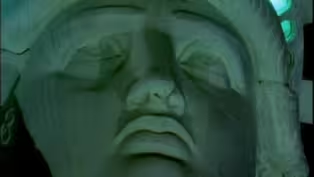
Carolyn Forche talks about how the Statue of Liberty is an enduring symbol. (31s)
Video has Closed Captions
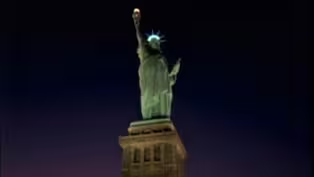
David McCullough, James Baldwin, Barbara Jordan and Milos Forman discuss liberty. (2m 29s)
Providing Support for PBS.org
Learn Moreabout PBS online sponsorship








Support for PBS provided by:
Funding Provided by: General Motors Corporation, the Corporation for Public Broadcasting, PBS, Liberty Mutual Insurance Company and the Henry Nias Foundation.