
Readers Club 305: This Is Not About Us | Allegra Goodman
Season 2026 Episode 16 | 36m 31sVideo has Closed Captions
New York Times bestselling author Allegra Goodman of Sam and Isola to discuss her brand-new novel
PBS Books Readers Club welcomes New York Times bestselling author Allegra Goodman of Sam & Isola to discuss her brand-new novel This Is Not About Us. This is Not About Us opens as the youngest of the three Rubenstein sisters passes away, and a petty dispute at her funeral over an apple cake splits the remaining sisters apart. Each chapter adds another layer to a family portrait that's complicated
Problems playing video? | Closed Captioning Feedback
Problems playing video? | Closed Captioning Feedback
Readers Club 305: This Is Not About Us | Allegra Goodman
Season 2026 Episode 16 | 36m 31sVideo has Closed Captions
PBS Books Readers Club welcomes New York Times bestselling author Allegra Goodman of Sam & Isola to discuss her brand-new novel This Is Not About Us. This is Not About Us opens as the youngest of the three Rubenstein sisters passes away, and a petty dispute at her funeral over an apple cake splits the remaining sisters apart. Each chapter adds another layer to a family portrait that's complicated
Problems playing video? | Closed Captioning Feedback
Where to Watch PBS Books
PBS Books is available to stream on pbs.org and the PBS app.
Providing Support for PBS.org
Learn Moreabout PBS online sponsorshipMore from This Collection
The PBS Books Readers Club is a monthly digital-first series that brings its members into conversations behind the stories of your favorite books & shows. You can watch the online on the PBS App, with extended interviews available for PBS members on PBS Passport.
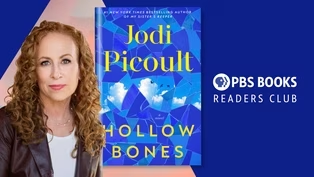
Readers Club Episode 309 Hollow Bones | Jodi Picoult
Video has Closed Captions
PBS Books Readers Club welcomes prolific author Jodi Picoult to discuss her newest novel (46m 12s)

Video has Closed Captions
PBS Books Readers Club welcomes author Andy Weir to discuss his best-seller Project Hail Mary (40m 24s)
Readers Club Episode 307: Booking It Across America
Video has Closed Captions
This month, PBS Books Readers Club celebrates America 250 with a special episode (15m 49s)
READERS CLUB Episode 306 : Our Favorite Books for Summer
Video has Closed Captions
Our hosts of the PBS Books Readers Club, share their perfect picks to binge beachside this summer (18m 45s)
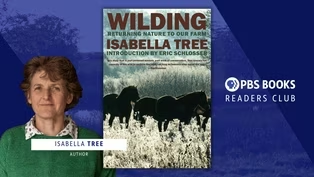
Readers Club 304: Wilding | Isabella Tree
Video has Closed Captions
PBS Books Readers Club welcomes British author and conservationist Isabella Tree (33m 17s)
Readers Club- Debbie Horsfield | The Forsytes
Video has Closed Captions
The PBS Books Readers Club takes on John Galsworthy's classic novel series The Forsytes. (32m 36s)

Readers Club | 302 Book Picks for Black History Month with Lauren Smith and Princess Weekes
Video has Closed Captions
PBBS Books Readers Club recommend their favorite Black History Month reads. (16m 16s)
Readers Club | Ep 301: Charlotte McConaghy | Once There Were Wolves
Video has Closed Captions
PBS Books Readers Club hosts author Charlotte McConaghy to discuss her novel Once There Were Wolves. (58m 55s)
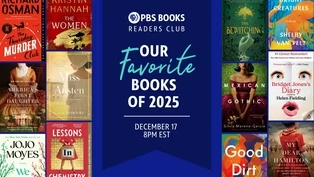
Readers Club | Ep. 212: Our Favorite Books of 2025
Video has Closed Captions
PBS Books Readers Club celebrates the wrap of its second season with a highlight of 2025 (47m 55s)
Readers Club | Ep. 211: America's First Daughter | Stephanie Dray & Laura Kamoie
Video has Closed Captions
PBS Books Readers Club welcomes co-authors Stephanie Dray and Laura Kamoie (1h 1m 45s)
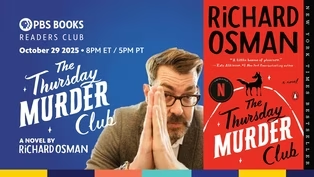
Wed Oct 29 2025 | Readers Club | Ep. 210: Richard Osman | Thursday Murder Club
Video has Closed Captions
PBS Books Readers Club welcomes celebrity writer Richard Osman to discuss his best-selling novel (52m 44s)
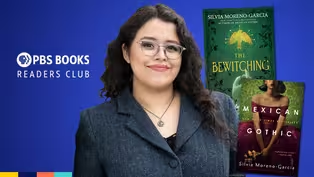
Readers Club | Ep. 209: Silvia Moreno-Garcia | The Bewitching and Mexican Gothic
Video has Closed Captions
PBS Books Readers Club welcomes award winning author Silvia Moreno-Garcia to discuss her new book. (52m 42s)
Providing Support for PBS.org
Learn Moreabout PBS online sponsorship(bright string music) - I would describe my relationship to my characters as like a parent of grown children.
And we know how much they listen to us, right?
But we can influence them to a certain extent.
So, you know, there's this sort of dance between organization and improvisation in my work.
(bright string music) - Well, hello, and welcome to the "PBS Books Readers Club."
Today we're excited to welcome bestselling author of books that include "Isola" and "Sam," Allegra Goodman.
Today we'll discuss her newest novel, "This is Not About Us."
When the youngest of three sisters passes away, a petty dispute over an apple cake, of all things, splits the remaining two apart for over a decade.
This family saga travels through marriages and divorces, bat mitzvahs, and college applications as three generations of the Rubinstein family navigate life's losses and celebrations with equal parts humor and heartbreak.
If you've had a chance to read "This is Not About Us," tell us what you thought in the chat or the comments.
Also, if you've read any of Allegra Goodman's other books, let us know that too.
I know, for me, "Isola" was one of my favorite reads last year.
I'd love to hear what you think.
And be sure to stay tuned after the interview for this month's book recommendations.
We've got some good ones for you.
Joining me today for our discussion with Allegra Goodman is our resident librarian, Heather-Marie Montilla.
Hi, Heather.
It's so good to see you.
- Hey, Lauren.
It's so great to be back on this show.
Thanks for having me.
- Yes.
So, what did you think about "This is Not About Us"?
- I loved it.
I really enjoyed the book.
You know, I lived in New York City for more than 15 years.
I spent a lot of time in New England.
I know you've spent some time up there too.
And so it conjured for me a lot of memories.
I'm from a family of musicians.
I have a son who's a violinist.
I have a sister in my... You know, from growing up, obviously.
And so this book is about family.
It's about this complex interpersonal relationships.
And it's beautifully written.
The character development is amazing.
And it's about life.
And I love the different perspectives, and really how she embodies each person when she's telling the story from their perspective.
It was incredible.
- Yeah, I love how she got into the perspective of the different generations of family and how sometimes they see eye to eye, sometimes they don't.
She's writing from the perspective of kids and young adults, and also somebody that's older and on their deathbed.
And I think having those different perspectives from the people in just one family and how different they are, I think everybody can find somebody in this book that is going to remind them of their own family.
And I think that it's just so relatable and so real.
- Agreed.
It's one of those books that I think I'll come back to for a long time.
- Yeah.
And I'm going to share it with a lot of other people too.
So, Allegra Goodman is standing by to join us in just a moment.
We can't wait to talk to her.
But first, make sure you stay in the loop on all of our PBS Books author talks and more.
Sign up for our PBS Books e-newsletter at pbsbooks.org/subscribe for exclusive book recommendations, author interviews, and more.
And subscribe to the PBS Book's YouTube channel so you never miss an episode.
And don't forget, PBS Books is supported by viewers just like you.
Now more than ever, we need your help.
So, please, if you can make a gift today by going to pbsbooks.org/donate, you'll be taken to your local stations giving page where you can select one of our special "PBS Books Readers Club" gifts as our thanks.
Check out the "My Weekend is BOOKED!"
mug, or my favorite, the library tote bag.
(bright string music) Let's welcome our guest, the author of "This is Not About Us," Allegra Goodman.
Allegra, thank you so much and welcome to the "PBS Books Readers Club."
- Thank you for having me.
- We are so excited to launch into this conversation.
For those of us that haven't read it yet, tell us a little bit about your book, "This is Not About Us."
- "This is Not About Us" is the story of three generations of a Jewish American family living on the East Coast.
And it is about their family dramas, their fights, the way they love each other, the way they make each other crazy.
And it's from the point of view of the older generation, the grandparents, the middle generation or middle aged, and their young adult grandchildren.
- This is quite a large cast of characters, but all the characters seem so incredibly authentic.
I feel like we all know so much about them.
And you've woven this beautiful web of members of this family.
Can you talk a little bit about character development?
Did you make a family tree first?
Did you go one family at a time?
Can you share a little bit about how you went about it?
- Of course.
Well, I wrote this book gradually over a number of years, and it really started with the apple cake episode at the beginning of the book, which is the beginning of a rift between two of the sisters over a cake.
But of course, it's not really just about the cake.
- It's never just about the cake.
- It's never just about the cake.
Yeah, the recipe, the cake.
You know, it's never just about that.
But in this episode, all the members of the family are gathering together at the sick bed of the third sister.
And as they gathered, I started thinking, as I was writing this, that I'd like to pursue each of these members of the family and find out more about their lives.
So, the book kind of grew organically, like a tree, from that apple cake episode at the beginning.
- Did any of the characters change in an unexpected way when you started with that scene of the apple cake into the tree that grew and their backstories?
Did any of these people change into someone that you didn't expect along the way?
- It's kind of funny.
It's not so much that they changed, but that my perception of them changed.
And I think the reader's perception of them changes because I began to delve deeper and adopt their points of view.
So, for example, Richard, who is going through a divorce at the beginning of the book, we sort of hear his point of view of the marriage and the divorce.
And then as we go on, we suddenly have the perspective of his ex-wife, Debra, who has a very different point of view.
And, you know, they all sort of become more well-rounded and more human for the reader as we delve deeper.
- If you can tell us, and you started a little bit to tell us about your writing process, but maybe if you can delve into it a little bit more.
We've met so many wonderful authors since the "Readers Club" began, and it really seems that every author has their own style and their own approach.
You said you did it over a handful of years.
If you can talk a little bit about how you approach that writing process and those specific stories.
'Cause I know sometimes people have it all planned out and outlined, and other times, really, the stories are being created by the characters.
So if you could talk a little bit about your style.
- I'm sort of do a dance between trying to control and giving up control.
I would describe my relationship to my characters as like a parent of grown children.
And we know how much they listen to us, right?
But we can influence them to a certain extent.
So, you know, there's this sort of dance between organization and improvisation in my work.
This book in particular, I see it as a serial novel because I wrote it small parts gradually over a long time and published many of the pieces in the New Yorker and elsewhere.
And so I had the benefit of actually readers responding to those pieces in the magazines and writing to me and saying, "I'd like to hear more about Lily," or, you know, "What happened to Debra?"
Or, you know, "More about this one."
And also encouraging me to keep going.
The germ of this book, the very beginning with that apple cake story, began when my daughter was quite young and taking a rowing class at the community boathouse.
And it was a class on Sunday mornings from nine o'clock in the morning till noon.
And so I went to a Starbucks across the way.
The class is on the Charles River.
I live in Cambridge, Massachusetts.
And I just started working on this project only on Sundays during those hours of the once-a-week rowing class.
And I got in the habit of working on this project on Sunday mornings and kept at it even after she quit rowing.
- Wow.
- That's amazing.
I mean, I kept having this feeling as I was reading it that every family is like this.
I think there's something that, no matter who you are, you can take a piece of this book and relate it back to your own family.
Can you talk about why you wrote this book?
What was the inspiration?
Are there bits of your own family that are in here somewhere?
Or is it really not about you?
- Well, I find families to be a tremendously rich subject.
I mean, if you want to talk about politics, talk about family.
You know, it's all there in the microcosm, right?
It's kind of funny, when I finished writing this book, I sent it to my daughter who is now grown up and living in London, working there.
And she said, "I think it's really cute how you labeled the document 'This is Not About Us' to reassure the family."
And I said, "I'm not reassuring the family.
That is the title of the book."
And then there was this sort of long pause and she said, "It is about our family."
And I said, "Well, you're going to have to read it and find out."
You know, I think there are elements of things that I've observed, things that I've experienced, but I deny them all.
And I tell readers, I advise readers, if you do see something that looks maybe too close to home or hits really hard, I advise you to deny it as well.
(all laughing) - You're funny.
- That's brilliant.
(all laughing) So you talked a little bit about the apple cake.
So, I lived in New York City, actually in Riverdale, in a predominantly Jewish neighborhood for over a decade.
And certainly especially around Rosh Hashanah apple cake's super popular.
Can you talk, though, maybe from your own experience, apple cake, is it important to you, the significance maybe within your own family?
I know it's not about your family, you already told us that, wink, wink.
But can you share a little bit about... - Yeah, and people have even said, "So what's your apple cake recipe and what's your baking like?"
And I always say, "I do my baking on the page."
Like, I am not really a baker.
But my mother was a great baker.
And she made apple strudel and harder things than apple cake.
She did linzertorte and Mandelbrot and rugelach, and really hard stuff.
- I love rugelach.
- Yeah.
The thing that makes Helen crazy about Sylvia's apple cake is it's an easy recipe.
It's much more accessible and easy, and it's delicious.
But Sylvia is kind of a home baker and intuitive baker, and she's not too fussy.
And then everybody loves it.
And that makes Helen crazy because, you know, it's, like, the simple things.
It's too sweet.
It's too simple.
It's facile.
You know, it really bothers her that somebody can sort of pull something off without a lot of effort, 'cause Helen is very diligent in her baking.
And I'm interested in people and what their baking might say about them, you know, of course.
So yes, I am not myself a master baker by any means.
- Yeah.
I just baked, I think, my first set of cookies that I've ever baked, like a week ago.
They were not good.
- No, it takes time.
You have to give yourself grace.
- But my sister-in-law makes an amazing apple cake, so I thought about that the whole book.
One of the reoccurring themes throughout the book was the different views and relationships that people had with religion, in particular the Jewish faith, and how that played out in their lives, even for different characters within the same family.
Can you talk to us a little bit about that?
- I'm really interested in what people believe more broadly, you know, and also the role of tradition in people's lives.
We have a lot of choice here in America about what rituals we want to follow and what we don't want to follow.
So, why are people then drawn to practicing certain rituals and celebrating certain holidays?
The family in this book are Jewish.
They're not super observant Jews.
Some of them don't believe in God.
Some of them go to temple once a year.
Some of them are sort of more committed to more everyday practice and want to have a bat mitzvah, you know.
But I would describe them as, you know, a family of American Jews who are diverse and, you know, have different practices.
And I would say the religion means different things to the different people.
And I'm very interested in that diversity.
- You know, the beginning of your book I felt really underscored that, even with Jeanne, who's on her deathbed it, you know, who is an atheist or an agnostic, maybe agnostic, and just having people sweep in to try to decide her last wishes.
- [Allegra] Right.
- Is that something you've observed with friends or extended family, or how did you... Because I can imagine that happening within a family, and I think that's what's so amazing about your book, all these situations.
I'm like, "Oh yes, that could happen in my family."
Right?
- Yeah.
- So can you talk a little bit about your inspiration for some of these very crafted scenes?
- Thank you.
Well, you know, and a deathbed is where, you know, matters of spirituality and religion do come into play.
And it is very irritating to Jeanne, you know, that all of a sudden her family is starting to get spiritual on her.
"They must be really giving up on me now," you know?
And, you know, one sister brings in a rabbi to speak to her and she tells the rabbi, "I don't believe in God," and he's very understanding.
And then she's offended because it's like, "Don't rabbis believe in anything anymore?"
You know, like, she wants to have an argument.
So, you know, I was interested in sort of the humor in that and the pathos in that.
And when Jeanne is passing away, when she's dying, there's a lot of fear in her family and there's kind of awe, and there's, you know, wanting to respect her wishes and sort of striving for something to hold onto spiritually.
And I see all of that, you know, in our world.
And people have said to me, who've read this book, you know, that they recognized, you know, when their grandmother was dying, you know, when the hospice worker said, you know, "Maybe she needs to let go of something."
And you know, in my story, everybody's trying to think of, like, what to let go of.
(laughs) "Should we all forgive each other now?"
You know?
- [Lauren] Yeah.
- So... - Well, yeah, I thought it was very interesting, too, to hear from the perspective of a person who was dying.
Because I think that's not a person that you get to embody very often.
And I thought that was just really interesting.
And then also the way that you wrote from the perspectives of different people from different generations.
I don't know how you got into the mind of a teenager or a young adult so well.
It's so different from her grandmother.
Talk to us about, like, getting in the heads of these different generations.
- Oh, thank you.
Well, that was really the fun of it for me, was, you know, showing these different perspectives and being an 11-year-old girl and being a woman in her seventies who's dying of cancer, and being the aggravated middle-aged sons who are trying to figure out how to celebrate her life when she doesn't want to be celebrated in the way that they do, you know?
And so I would say that that's really my art and that's my job, you know, to get inside of people.
And, you know, I take what I see.
I observe the world, and what I see in the world is happy and absurd and also sad.
And I like to work with those colors in my books.
- So, as we talk about your art, you also have woven in beautifully art.
Art as a music, art as the Gardner Museum, right?
You have art as a theme.
Phoebe as a violinist.
You have a cello player, right?
Can you talk about the importance of art and multiple arts as a theme?
Because it is such a important, especially... Even an instrument.
I mean, I think the... My son plays the violin, right?
So when you are talking about conserving a violin and the cost of it, you know, I thought of what my son would say, you know, and he'd be like, you know, "I can't afford it."
So he probably wouldn't put glue on it or... But it made me laugh and it just rang so real.
So maybe the importance of, you know, music and visual art, maybe to you, your family, and why you included it in this amazing saga.
- Well, you know, if you're talking about people's spiritual life, I think that art is part of our spiritual life, and it is a big part of it.
In this family, it manifests itself in that way, you know?
So, on the one hand, there is Judaism, on the other hand, there is playing the violin.
And Jeanne was a music teacher, and Phoebe aspires to be a musician.
And they go to Tanglewood together, they have tickets to the Boston Symphony Orchestra.
I live in Cambridge.
And you know, we have this great symphony hall here, and Tanglewood's a big part of life here.
So, I was interested in weaving that in.
My mother played the piano quite well, and she played Chopin.
And her favorite pianist, her favorite recordings of Chopin were by Arthur Rubinstein.
And so I named the family the Rubinsteins as a nod to my mother and her love of Arthur Rubinstein.
So, I think I get it in part from my own family.
You know, music was important to my parents.
They gave me this musical name, Allegra, you know?
And I love music.
I played violin as a girl, but I don't play anymore.
But again, I make my music on the page.
- Yes, you do.
And I'm just going to compliment you a little bit more because one of the things I love about you as a writer is that your books are all so different and you're able to write in different... Like, last year, one of my favorite books was "Isola."
And first of all, I say it different every time.
Is it "Isola" is it "Isola"?
What's the right way?
- I have a friend who speaks Italian, and she explained to me that it's "Isla."
- "Isla."
Okay, well, I've never said it correctly.
- No worries.
We're American.
What do we know?
It's fine.
- Yeah.
What do we know?
But I love that book.
And it was, you know, deep historical fiction, sort of this epic story.
Completely different from "This is Not About Us."
How do you do that?
- Well, I describe "Isola" as like time travel.
And I was writing them at the same time, these two books.
So this one I was working on Sundays and "Isola" I was working on during the week.
That's why I had to work on this one on Sunday mornings.
- That's crazy.
- It is really, really a different book and a different time and place.
It is also a book that... That historical novel, which I should say, for people who haven't read it, is about a French noblewoman who sails to the new world and is marooned on an island in the Gulf of St.
Lawrence based on a true story.
It also deals with spiritual life, how to live, why we should live, you know, how to survive, and family, the families that we choose and the families that we are born into.
And so it has some of the same underlying themes, although it is very different in voice and time and place and structure.
- I was thinking about the book and just how both books are, as Lauren said, so incredible.
Do you have any other books that you've been working on?
I mean, it's pretty incredible to write these two very different, both inspiring books.
Is there something you're working on now and do you always work on two books?
I mean, who knew?
- No, I have not worked on two books, except for this case.
In the last five years, I worked on three, "Sam," "Isola," and this one, and they all overlapped each other.
But I don't think it's a coincidence that I began doing those three projects when my youngest daughter went to college.
So, I call it being an empty-nester.
So, until then, I was never able to do more than one thing at a time.
And my oldest son, who is now an economist, labor economist, said to me, "I have noticed that your productivity has gone way up since we all left home."
- Does he talk to you about positive externalities as well?
- Yes.
So I had four children.
- I have a while until that happens.
I'm trying to enjoy it.
But wow, I'm going to be able to do amazing things one day.
(all laughing) - I'm currently working on just one new book.
We'll see what else emerges.
We'll see what else happens.
But right now just the one.
- Well, we can't wait to read it.
One other thing that I liked about this book.
Well, there's many things.
But the way that you ended it, and I'm not going to spoil it for anyone that hasn't read, but you almost can't spoil it because you don't button it up as this, like, beautiful package.
And I thought that was so fascinating because family life and relationships don't always mend themselves all at the same time.
So talk a little bit about that decision.
- I mean, I think it really comes from just trying to be real, trying to write what I see.
People don't always resolve all their differences.
One reader said to me, "How come Helen and Sylvia can't, like, figure it out?
How come they can't work it out with each other?"
And I was like, "Well, why don't we have world peace?"
You know?
People are complicated.
You know?
It's not easy.
If it was easy, there would be no trouble in this world.
So that's what I see.
I see that people fight and they have friction, and they have differences that are not always easily resolvable.
- It did feel very real to me when I was reading it.
And I think, you know, we made that point several times, just that these characters could very well be us or our dad or our grandma, you know, our auntie.
It's just you did a great job capturing the reality of family life.
I have a few fun questions for you too.
Did you always know that you were a writer, even before you were an empty-nester, or did that realization really come later?
- No, I always wanted to be a writer since I was a little girl.
And before I was an empty-nester, I wrote quite a few books.
I've just gotten more productive as I've gotten older.
I decided I wanted to be a writer when I was seven years old.
I was living in Honolulu, which is where I grew up, on Oahu.
And I read "Little House in The Big Woods," which has that famous opening about two little girls living in the little house in the big woods, and all you could see was trees.
Trees as far as the eye could see.
And I thought, when I read that, I was going to write a book about me and my sister Paula, and they lived on an island in the Pacific Ocean, and all you could see were waves as far as the eye could see.
Like, I just wanted to map that book onto my own experience and imitate it because I loved it so much.
So, yes.
So, when I was seven, I decided I wanted to be a writer.
And you know, by end of high school, I was seriously writing short stories, started publishing in college, and really started quite young and kept working very steadily.
- So, what is your ideal writing setup?
Are you a morning person, a night owl?
Do you listen to music, maybe some Chopin, or do you work in your home or a coffee shop?
How do you like to write when you write?
Obviously, we already know a little bit that you like to write at Starbucks while you have a daughter rowing.
I don't have to do that during soccer and ballet and rowing anymore.
I used to work a lot in my car.
You know, you do what you can as a mom.
- I know.
As mothers, we do.
- Yes.
- That's what we have to do.
- You know what I'm talking about.
- Yes.
And I'm nostalgic now, you know, actually.
But I am a morning person, I do my best work like before 10:00 AM.
After lunch is kind of downhill for me.
So, I really like to get going early.
I like to go for a swim really early in the morning and then get going by eight o'clock in the morning and work till lunchtime.
And then in the afternoon I'll try to do a second session where I'll either revise what I did in the morning or work on something else.
When I was doing several books at once, I would work on one in the morning and one in the afternoon session.
And I usually do the easier work in the afternoon.
And yeah, I don't work at all at night.
I can't... Like, when the sun goes down, forget it.
I am a solar-powered unit.
You know, I like to work in the morning.
It's 'cause I come from a tropical place.
And I don't work on Saturdays.
I work on... And then Sunday mornings I reserve for either essay writing, book reviews, or short fiction, or something like that.
So, Monday to Friday.
- Well, you seem to be very disciplined.
- I am kind of... I try.
- That's amazing.
That's so cool.
We'd also love to know about any good books that you've read lately.
Any recommendations that you have?
- Yeah, so one of the books I read lately is called "Bad Bad Girl" by my friend Gish Jen.
And it is a book about a Chinese writer and her very difficult relationship with her immigrant mother.
And it's about being an immigrant and it's about China and her mother's history.
And it's very poignant and funny in places.
And yeah, I try to sort of keep up with, you know, kind of new fiction, but I also read a lot of nonfiction and biography and history, and I read books for my work as well.
- What's your favorite book from childhood?
- When I was really little, even before I could read, I think my favorite book was "The Wizard of Oz."
And I loved that book so much I named my doll Dorothy.
And, you know, I own all of the ones that were written by L. Frank Baum, like the 14 original ones.
- Yes.
Of course.
- Yeah, I have that series.
And so that was my obsession.
By the time I got to sort of middle school, I was getting into, like, Victorian novels, and I loved, like, "The Pickwick Papers."
I loved Dickens' humor, and I loved his detail and the way he created entire worlds.
From there, by 16 I was really, like, deep into the 19th century, reading, you know, "War and Peace" and "Middlemarch" and books like that, and just these.
And really thinking about the novel not just as a story of one person but as a story of a whole community.
And you can see that even in this book that I'm interested in those multiple points of view, which is something Tolstoy does so well, and George Eliot.
- So, do you have any advice for aspiring writers?
Have you received any advice that you really appreciated?
And what advice would you give?
- The best advice I ever received as a writer was from my grandmother, who was a poet.
And she said, it's very simple, "Don't rush."
She said, "Don't push too hard.
Don't force it."
You know, "Your work will be better..." What she was saying, she didn't expel it out this way, but what I've come to understand is, "Allow yourself to play.
Allow yourself to love what you're doing.
Don't slog through it, or the reader will also be slogging through it.
Allow the fun and the love to show in your writing."
And for me, that translates into not pushing too hard or not trying to write too much in a given day, but just being very gradual and steady.
And what I would tell aspiring writers is that don't try to do too much a day.
Even if you wrote one page a day, by the end of a year, you'd have enough for a book.
You know, even if you wrote a paragraph a day, after a few years, you would have, you know, a substantial amount of work.
It adds up.
So, focus on quality rather than quantity.
- That's great advice.
I'm writing down "don't rush," because I think all I do is rush, so I'm going to try to embody that.
- Before I ask my last question, I'm dying to know if you have a favorite library.
- Oh, a favorite public library?
My library here in Cambridge.
We have the most beautiful public library here, and I hope that someday you'll come visit it.
It was originally a Victorian building that was then expanded with... You know, quadrupled in size with a glass addition, and it's airy and light and we have a children's floor on the third floor, and it's just full of sunshine, near a playground.
And it's just the nicest thing in my city, really.
- I love that.
Finally, Allegra, is there anything you would like to say to your readers?
- Ooh, my readers of this book?
- Of any book.
- Any of my readers.
- You have many.
- Oh, I would say thank you.
Thank you for taking time to read a story, to unplug, to look at something... To look at a longer narrative, to immerse yourself in other lives.
Thank you for laughing.
Thank you for crying.
You know, thank you for engaging the way you do and welcoming these characters into your lives.
- That's beautiful.
Allegra Goodman, thank you so much for joining us on PBS Books today.
- Oh, thank you.
It was such a pleasure.
- What a fabulous conversation.
I loved hearing Allegra talk about her inspiration and her writing style and all of it.
She was fabulous.
What did you think, Heather?
- She was incredible.
I mean, she was funny, witty, everything... I guess none of it surprised me based on reading her writing, but she was so personable to give us little insights into even where her name came from, right?
Or Rubinstein, why that is the last name of the family.
I love the little tidbits we got from her.
Or really even her talking about her favorite authors as a child.
It really helped me to understand why she writes in the way she writes.
She's an incredible woman and I'm just so glad we got to speak with her.
- Me too.
Allegra, you're welcome back on our show anytime.
We'd also love to leave you with some great book recommendations.
I know, Heather, you have some good ones too.
But first, a reminder that you play a major role in making PBS Books happen.
Seriously, we can't do it without you.
This and all of your favorite PBS programs rely on donations.
So, now more than ever, we need your support.
Join your book Friends in supporting these programs, just click the link in the description or comments, or visit pbsbooks.org/donate.
You'll be taken to your local PBS stations donation page where you can find PBS Books swag as our thanks for your gift.
The mug is a big hit and I just love the "PBS Books Readers Club" book bag.
It's my go-to for library halls.
Plus, as a member of your PBS station, you can stream hundreds of inspiring PBS shows, concerts, dramas, and documentaries with PBS Passport.
Okay, so let's dig into some book recommendations.
I've got my bag.
So, of course, May is Jewish American Heritage Month and we certainly appreciated Allegra Goodman's complex view of a modern Jewish American family.
In that vein, I'm also reading a book called "Fagin the Thief," by Allison Epstein, a historical fiction novel that reimagines the backstory from the classic character Fagin from Charles Dickens' "Oliver Twist."
In the book, young Fagin grows up in a poor Jewish neighborhood, discovering his knack for pickpocketing.
He even mentors a young Bill Sikes.
This book reminded me a little bit of the story in "James" by Percival Everett, in that it really rounds out a misunderstood character in such an interesting way, showing his compassion and ability to survive in a harsh world.
Now, May is also Asian American and Pacific Islander Heritage Month.
I just read a great book by Christina Li called "The Manor of Dreams."
And this one, it's so good, it's a little spooky.
It's a gothic tale about a woman who becomes the first Chinese actress to win an Oscar.
After her death, her family gathers in her crumbling and very spooky Hollywood mansion to contest her controversial will.
Fans of books like "Mexican Gothic" will love this gripping tale of a house and family haunted.
So, Heather, what is on your list this month?
- Well, this month I put other books that really, if you read "This is Not About Us," it would be something that you would also want to read alike.
Also with the Jewish American theme, continuing with that.
I really like Catherine Newman.
She wrote "Sandwich" and "Wreck."
Both of them, it's kind of like a 1-2, they really focus on a family and empty-nesters or the growth of... The family saga.
A lot of it is from the mother's perspective, Rocky, but you also get the other perspectives as well.
It brings humor, heart, complexities of family life, how difficult it is to get older.
It captures those small revealing moments that define relationships.
It also, as a mother with, you know, range of ages, it helped me to really appreciate those small moments that sometimes you maybe are getting mad, but here you're reading a book by a mother who's older who's telling you how important it is to treasure those little moments, right?
And so it really helped me to change my perspective.
So I'm going to read it again, is the point.
Also, "Wreck" is the second one in the series and it is rich, it's multi-generational story, it's tension, it's identity.
It explores really family, wit, Jewish culture, and it feels, similarly, deeply human.
What I would say is Catherine Newman is hilarious.
She's just a funny person, and that really comes out in her work.
And unlike Allegra, Catherine has admitted that her books are completely inspired by her family.
- "This is About Us".
- And that makes it even more funny.
So, both are worth a read and I hope people enjoy them as much as I do and as much as I'm about to again.
- Well, thank you, Heather.
Those are great recommendations.
I can't wait to read those too.
There's so much in my reading list.
Heather, we're so glad you could join us today.
It was great to see you.
- It was great to see you too.
I was so happy to be here.
Enjoy reading more.
- And we are so grateful to you at home for joining us as well.
If you enjoyed this author talk, then be sure to join the PBS Books Readers Club Facebook group for great conversations and book recommendations all month long.
And subscribe to the PBS Books YouTube channel, where you can watch hundreds of other author and filmmaker talks like Kristin Hannah on "The Women," Shelby Van Pelt on "Remarkably Bright Creatures," and so many more.
If you'd like to explore more on the topic of Jewish American heritage, visit the PBS app.
There you'll find programs like "Black and Jewish America," the latest film by Dr.
Henry Lewis Gates Jr., "The U.S.
and the Holocaust" film by Ken Burns, "Great Performances, Broadway Musicals: A Jewish Legacy," and more.
Looking for more book recommendations to stack your TBR list?
Subscribe to our e-newsletter at pbsbooks.org/subscribe.
You'll also be the first to find out about our book pick for next month.
We will see you next time.
Thanks for reading with us and for watching, and thanks for being a part of the "PBS Books Readers Club."
(bright string music)













Support for PBS provided by: