
Chris Fleming Embraces the Chaos
Special | 39m 17sVideo has Closed Captions
Comedian Chris Fleming talks about the process behind his iconic manic stage persona.
Comedian Chris Fleming traces the origins of his manic stage persona back to his childhood in rural Stow, Massachusetts. We also discuss his drive to provoke his audience, while still grounding his work in empathy, his opposition to perfectionism, and the importance of expressing yourself as authentically as possible.
Problems playing video? | Closed Captioning Feedback
Problems playing video? | Closed Captioning Feedback
Support for American Masters is provided by AARP, The Rosalind P. Walter Foundation, Thea Petschek Iervolino Foundation, Burton P. and Judith B. Resnick Foundation, The Philip and Janice Levin Foundation,...
Support provided by:

Chris Fleming Embraces the Chaos
Special | 39m 17sVideo has Closed Captions
Comedian Chris Fleming traces the origins of his manic stage persona back to his childhood in rural Stow, Massachusetts. We also discuss his drive to provoke his audience, while still grounding his work in empathy, his opposition to perfectionism, and the importance of expressing yourself as authentically as possible.
Problems playing video? | Closed Captioning Feedback
Where to Watch American Masters
American Masters is available to stream on pbs.org and the PBS app.
Buy Now
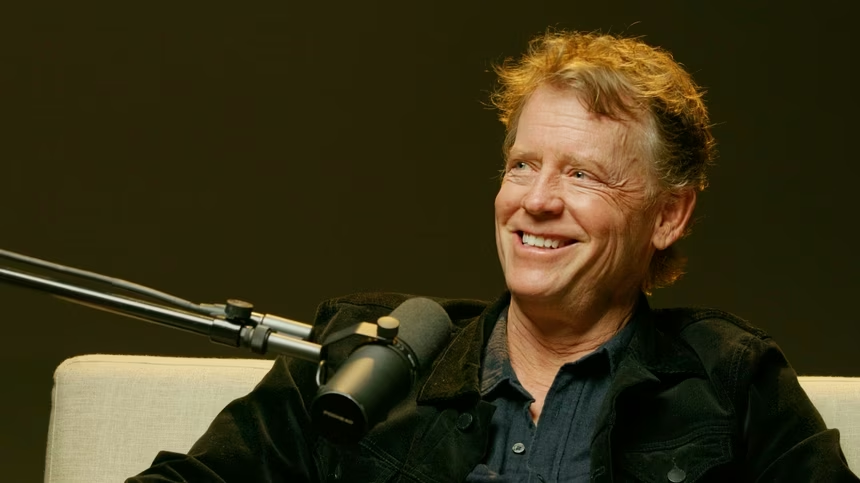
A front row seat to the creative process
How do today’s masters create their art? Each episode an artist reveals how they brought their creative work to life. Hear from artists across disciplines, like comedian Chris Fleming, actor Greg Kinnear, sports journalist Taylor Rooks, and more on our video podcast "American Masters: Creative Spark."Providing Support for PBS.org
Learn Moreabout PBS online sponsorshipMore from This Collection
How do today’s masters create their art? "Creative Spark" presents narrative interviews that go in-depth with an iconic artist about the creation of a single work. Each episode offers a unique window into the world of art and the creative process of artists and cultural icons across a wide range of disciplines, from music and comedy to poetry and film.
Mike Faist Embraces the Unknown
Video has Closed Captions
Actor Mike Faist explores the creative process behind his work on East of Eden. (44m)

The Many Passions of Matteo Lane
Video has Closed Captions
Comedian Matteo Lane on stand-up, painting, singing, performing on Broadway and much more. (55m 8s)
Michael Sarnoski: What Robin Hood and Folklore Tell Us About Ourselves Today
Video has Closed Captions
Filmmaker Michael Sarnoski breaks down his revisionist version of the Robin Hood story. (28m 4s)
Tyler James Williams on 30 Years of Acting and Protecting the Next Generation
Video has Closed Captions
Actor Tyler James Williams talks about his acting process and what drives his work. (35m 23s)
Why Atsuko Okatsuka’s Comedy Connects Across Cultures
Video has Closed Captions
Comedian Atsuko Okatsuka returns to the show to talk about her creative process. (30m)
Greg Kinnear on Acting, AI, and Why Movies Still Matter
Video has Closed Captions
Oscar-nominated actor Greg Kinnear shares some "big thoughts." (27m 33s)
How Leslie Jones Became a Comedian
Video has Closed Captions
Comedian and actress Leslie Jones does a deep dive on her creative process. (31m)
Phoebe Robinson Shows Her Work
Video has Closed Captions
Comedian Phoebe Robinson takes on hustle-culture in biting comedy special. (31m 45s)
Sarah McLachlan: Making Music to Connect and Heal
Video has Closed Captions
Singer-songwriter Sarah McLachlan opens up in a candid interview about making music. (37m 19s)
How Natasha Rothwell’s Life Brought Her to “The White Lotus”
Video has Closed Captions
Actress Natasha Rothwell on her creative process in "The White Lotus." (33m 40s)
Daniel Dae Kim Leads Spy Drama and Fights for Industry Change
Video has Closed Captions
Actor Daniel Dae Kim on his groundbreaking career and new project, "Butterfly." (21m 48s)
Phil Rosenthal’s Secret Recipe: Good Food and a Laugh
Video has Closed Captions
TV writer and host Phil Rosenthal talks about finding our shared humanity in food and comedy. (22m 53s)
Providing Support for PBS.org
Learn Moreabout PBS online sponsorship- Do you have like a hard out?
- 6:00 AM, man.
- Okay.
I have to go to a pediatrician on deployment at four so- - You still see a pediatrician.
(laughs) That's good.
I remember not wanting to leave my pediatrician.
She loved Ron White, the comedian.
You know, Ron White?
- Yeah.
- It's, like, "Damn."
When you find out your doctor's taste in comedy, you kind of start questioning your doctor.
- [Joe] You're ready to find another GP.
- Like, your doctor better like Mort Sahl or something.
It better be like really heady.
Yeah, she was great.
So you got a pediatrician of four.
Okay, we'll get you outta here by then.
- Yeah.
Okay, right.
(Chris laughs) (upbeat music) - This is "American Masters: Creative Spark".
I'm your host, Joe Skinner.
Our guest today is Chris Fleming, a wordsmith, a fashion icon, and a wildly physical performer who pushes observational comedy to its absurd and manic limits.
We're talking about his special, "Live at the Palace" and how he got here.
Starting in Stow, Massachusetts, population, 7,000.
- It's so depressing to be the lesser known Stow.
(Joe laughs) 'Cause everyone knows Stowe, Vermont 'cause it's like the cider capital of the world and everyone's, like... I think the X Games are there and stuff.
But Stow without the E is just- - Yeah, so paint a picture of Stow without the E.
- Okay.
No streetlights.
A lot of... There was something called... (laughs) There's a farm there and the big event for our family would be going to see when the lambs are sheared.
And when we were young, we called it Lambie Day.
And we thought this was kind of a what it was called, and my sister found out the rough way.
(chuckles) I think maybe even high school being, like, "Hey, y'all, gonna Lambie Day?"
We were, like, "What Lambie day."
But that was one of the big things was going to see the lambs freshly shorn.
Yeah.
Yeah.
Whenever I take an Uber from Logan, when I go visit my family and I take the Uber from Boston to Stow, the drivers are always, like, "I'm never coming back here again."
Like, at night.
(both laughing) People get lost a lot.
It's very labyrinthian.
- Right?
Hilly.
- Just very deciduous.
A lot of... (laughs) The canopy, it's... I mean, the "Vich" is the best representation of Stow that I've ever seen.
- [Joe] Mm, that takes place there?
- It doesn't, but it it does to me.
Just the way they do the slow zooms on the woods that just looks like a (vocalizing).
That is stow to me Stow.
Stow, (exhales) I love it.
I love it.
- What was the creative spark that got you going at that age?
- Hmm, seeing my dad laugh as a child at Robin Williams made me be, like, "Okay, well, that's what I wanna do."
Even though I was really shy, but it was this piece of being, like, "Oh, yeah, I'm gonna be a comedian."
And even in kindergarten, I would sign my name, Chris, the comedian even though I was, like, silent, but it was, like, "That's what I'm gonna do.
I think the lack of things happening was really good for me and my friends.
We were constantly sketching.
We were putting on shows, we were making movies, game court.
Like, we were needing to entertain ourselves and create.
We were very creative as youth, I think.
It was, like, a very small world and in a way, I was, like, "I want fill this world."
It wasn't, like, "Get me outta here."
It was, like, "This world rocks."
(laughs) I wanna make things.
Like, my first bit in standup was like, it was a bit about how people love to tell you about when they see deer, which just shows how rural I grew up.
I was just riffing on- - (laughs) Very deer-centric comedy.
- I had like eight minutes on (laughs) people competing about the number of deer they saw.
Like, adults competing about the deer they saw that week and how that was a point of pride, and that's what I was doing as a teen.
And if anything, I was a little bit resentful of having to leave the nest and be, like, "Ah, (beep) there's more?"
Like, "Ah, the world."
- You have to expand your palate, it's bigger than just deer.
So what else is on the Stow?
Like, 10 minutes on Stow?
- Oh, I mean, the 10 minutes on Stow became hours on Stow in my... I did a character called Gayle.
She was in my standup, which was a woman from that town.
- Mike Labradoodle just got accepted to Carnegie Mellon, early acceptance.
Still waiting to hear back from Yale and Pomona.
Fingers crossed.
- I think about where I started in standup and I started in kind of a funky collective in Cambridge where people were stranger than me.
I had an inferiority complex.
It was a place called The Comedy Studio.
And there were people that were so eccentric, older people.
Gen X, I was really inspired by Gen X, I think, 'cause they were the generation above me and that was so cool to me how free they were on stage and I felt... The way that we were taught standup too, Rick Jenkins at the studio was always to teaching us to go deeper and deeper into our authentic self.
And same thing with my acting teacher in college.
I think of that as a formative thing, Kate Kelly was my acting teacher.
The way that she told me to throw that all away.
It's, like, you can't go into a performance with an idea of how you're gonna do it.
Like you have to... You're there right now and what's interesting is the release.
And so that means you're gonna... Like, you have to get comfortable, (beep) up.
Throwing away the idea of perfection because Stow, everything like.... My family, I come from perfectionists and I'm far from a perfectionist.
Like, I don't think I could be and release the amount of work that I do because yeah, you just can't.
(laughs) In this special, I think we did a really good job of that, of, like, we didn't want like a really polished thing.
We wanted a real thing in a beautiful space.
Like, the space is beautiful and stuff, but we wanted to keep the... Like, there is an entropy to my show.
There is like... (Joe laughs) Things fall apart.
I get really emotional.
I get upset with the audience.
And I was also responding to... At that time when I was starting on comedy, I was responding to what was happening in America in comedy, which was every standup was wearing like a button up shirt and a hoodie.
Everyone looked the same.
Or plaid shirts.
And even the best, you know.
And I was more into like Noel Fielding and British comics who were wearing the crazy (beep) and not even talking about it and I found that... When I discovered that, that clicked for me too because I was always trying to blend... (exhales) I dunno if glam is the right word, but, like, something bigger than just like a guy on stage with the mic.
- What drove that impulse?
Like, why?
Why did you want it to be bigger?
- That is a good question.
I always loved costume as a child.
I grew up with girls and so I was always, like, "They get to wear (beep)."
In a clothing store, I remember being, like, "Are you (beep) kidding me?"
It's like Oz versus Kansas.
Like, it's like women's section.
Yeah.
Come on.
It's like boom, boom.
Like these cool shoes.
And then the men's just like this Willy Loman tragic stuff.
It's like grays (laughs) and beige.
Occasional like taupe, at best.
And I just was, like, "Are you kidding me?"
So I think it was a desire to assimilate as well, because I would spend summers mostly with my mom, her sister, and my sister, and then my two girl cousins, Caitlin and Molly.
And I remember being, like, "(laughs) Like, why do I have to be this?
(laughs) Why do I have to be the dope in a shirt and tie?"
- Right?
- I think it was... So I loved pageantry.
I loved like when we could wear costumes, induce skits, for lack of a better word.
I felt such liberation in that.
And I was always prone to cross dressing (laughs) as a child.
All right, cut it up.
(laughs) Clip it.
(both laughing) I don't know, I felt... There are times where I feel... I mean, I talk about it in my special, there are times where I feel remarkable in the right men's attire.
And then there are times where it's, like, "No, I'm more inclined to wear this kind of a thing."
Also in, okay, Boston.
Boston pretends to be liberal, it's not.
That place is terrifying.
(Joe laughs) Of all the places in the world, it's one of the scariest places I've ever been.
Like, it is the most judgmental, (laughs) bigoted place, right?
And so wearing crazy clothes there was radical back then.
It was, "(beep) you."
It was that.
So I would wear stuff that I didn't actually even fully... My full evolution happened in California because I would've been killed in Massachusetts.
Elizabeth Warren would've put a musket to the back of my head (laughs) if I had gone as fully to where I am now there.
But a lot of it was, "(beep) you guys."
It was, "You want to go to a real party?
Alright.
Okay."
- You know, I've always loved, like, punk music and sort of, like, noise music.
Things that are sort of, like, saying F you to convention in different ways and filmmakers too like that, but then I know that you've described yourself as an empath in social settings.
And I have middle child syndrome, so I also sort of- - Oh.
- So you just got two AirPods in all day.
Talking to, "One second, one second, one second."
"Yeah, wait, she's got a point, you know."
"Oh, scare 'em out.
No, no.
Okay, guys, no, no.
Well, I hear you.
Yeah."
- Those two things, those two sentiments seem at odds with each other.
- They are, they are.
- What drove you as a performer to wanna say, "F you", but then you're also an empath.
- (exhales) I mean, a lot of it is, like, you know in the mob when they break your hand, but then they give you the money to pay for it, you know.
It's the aftercare.
That's a lot of my career, you know.
It's letting air out the tires, you know, it's not like, it's not (beep) you to death.
(laughs) It's a (beep) you a little bit.
(laughs) It's not like a destructive desire.
And again, with fashion, I don't wanna freak people out.
I do think that my mom was... She hates the show off more than anything especially... And she despises male grooming in particular.
She thinks that there was something, like, that... (laughs) It's almost like men have had enough.
It's like, you know, men have... They have it good enough.
They don't need to also... Like, anytime a man like cares about the way he looks, it's sinful.
So her opposition to showing off makes me at odds with myself.
Like, I do try to contain it to the... But it was always okay on stage.
So it's like putting so much on stage as a safe thing and then moving differently in the world.
You know, like... I don't feel the need to dress that flashy in reality.
It's more the statement on stage, I think.
- But the empath thing, that's very interesting because I also... In Massachusetts also, like I will cool down my flamboyance because again, I don't wanna say, "(beep) you" on the streets.
I wanna say "(beep) you" in the controlled space on stage, in the short statement that I can make.
- That makes a lot of sense to me.
So it's- - I'm a coward is basically what it comes down to.
- Socials environments can be really stressful and high anxiety and trying to keep that balance, and then the stage is like an outlet, essentially.
- Oh yeah, yeah, yeah.
I mean, it's part of why I really wanted fame as a young person was that so people could, like... To, like, contextualize my most extreme and then we can kind of chill the (beep) out.
- Chris Fleming's new special, "Live at the Palace", Lets you take a peek at that most extreme version of himself.
It's kaleidoscopic.
And you can feel the labor that went into it.
Carefully honing his craft over years of playing venues across LA until he honed it into something chaotic, but deeply relatable.
It's kinda rare to run into a work of art that speaks very specifically to a slice of a generation.
Which to me, I felt like the special speaks to a mid millennial.
- The slur of the millennial is also funny right now.
Like, there is a derogatory and it came outta nowhere.
All of a sudden it was like- - Yeah, crept up honest, didn't it?
- 'Cause there was... (laughs) Yeah, yeah.
And it's beautiful.
It means that we're aging and, you know, there was also that brief time.
Remember that brief time where we all everyone was, like, "Gen Z's gonna save us."
And then that kind of stopped 'cause that was before we learned that they take "SpongeBob" seriously.
You know, that they- (both laughing) - What is the slur of millennials?
- Dude, I mean, okay, it's... I think Zooey Deschanel did a lot of damage.
I think, you know, like there's the adorable stuff, and again, it comes to what we were talking about.
It's like... Making you yourself like a character.
Like, "Silly old me.
And then my little things that I..." That I think is the thing that is most mocked in the millennial culture.
- So what makes that such fertile ground for comedy in a way?
'Cause I feel like you're kind of riffing on that, but you're sort of transcending it 'cause you are doing characters in a way in the special.
- Oh, totally.
One of my mission statements is to never get cute with it.
I think there needs to be a brutal reality to it.
I think also the adversarial nature quality that I have with my audience, I think, is important.
And sometimes you see this in comedy now, there are certain, like, movements right now that have like a huge following and it can become a megachurch really fast.
Like, I've gone to live shows, it's 3,000 people and they're, like, cheering at, you know, short form improv.
And you need to occasionally be, like, "Stop it.
Enough.
Hey, no, you can't be clapping at everything."
Because otherwise you're creating a bubble.
Like, it's gonna burst.
Like, it can't be... You are also like a bit of a... You have to reprimand.
It's like a... (laughs) I don't wanna say it's like dog owning, but it's like there's a little bit where you have to be, like, "Hey, hey, hey, stop."
Like, "Don't love me that much."
- So then are you kind trying to just evolve as a comedian all the time to kind of stay ahead of that curve in a way."
- That's the way to do it, I think.
When something works, you've gotta throw away that formula, and it's really hard as a writer.
I find myself even right now, starting from scratch, it's a really vulnerable thing.
You know, like, people see this piece of work that you've polished, you know, that you were touring all summer and is really the best representation of where you are at that time.
And then you start from scratch and you're inclined to, like, revisit tricks and everything, but you can't.
And I think, yeah, two of all as an artist is brutal and that's why you see a lot of people stop standup when they become huge.
And they just be a personality or do podcasts or act or whatever because it's like you really... You're starting not from zero, you're starting at like -1,000 because the crowd has seen you... Especially getting new fans from the special, they've seen this like, you know, a lot of people made that really great, HBO.
There was a lot of stuff that went into that.
- Yeah.
- It's beautiful and then- - JB SMOOVE is in the special thanks.
- (laughs) Yeah, I mean, JB SMOOVE, he's in the special thanks.
(laughs) Good eye.
JB SMOOVE, I opened for him when I was in college and he blew my mind, he blew my mind.
So that's why he's in the special thanks.
Talk about a guy who is leading an audience.
He will do a setup for a bit.
There's a clip of him at the "Apollo" where for the first minute, everyone's, like, "What the hell is he doing?"
And then the way he gets them, because he's gonna do what he's gonna do and he's leading them without pandering.
It's so easy to pander now.
It's so easy to signal and to pander on both sides.
And you have to forget all that, I think.
- So you're at a critical moment right now then because you are getting a lot of attention.
You are a standup, standup in a lot of people's minds, but you are getting a lot of attention as like an identity, as like a persona.
So how are you balancing that?
- Oh.
- Or do you just not even think about it?
- I don't.
No, no, for me it's, like- - Yeah.
- I just have such conviction with what I think is funny and what I wanna do.
Writing is always the thing that saves me.
If I weren't writing, I could easily be, like, "Oh, yeah.
Oh yeah, these people are right.
Okay.
Oh, yeah.
(laughs) Oh, maybe I'm good."
But it's, like, if you're writing and you're trying out new (beep), like you see how not great you are so fast and it's just... That's why standup is so wonderful.
And yeah, writing constantly just keeps you realizing how pathetic you are.
(laughs) No, that's not helpful.
(both laughing) - When you stick to the process, it sounds like it keeps you humble and keeps you in the craft of it.
- Yes, when you make a special where I'm, like, "That is..." We had a screening of that and I was, like, (laughs) in the audience, like, laughing.
When you make something where you're, like, you're firing at the height of your powers and then the world thinks that's, "Oh, that's Chris."
It's like that's me with a lot of people helping me out with putting a lot of work into that, and that is an A plus paper and now now that I've passed that in, I'm, like... Just being okay, completely starting over is a way that you will never get too egomaniacal, I think.
I mean, because you have to... The work is just what I think saves it, I think, and you can't.
You know you're not a gladiator when you, like... Or a successful gladiator when you start working again and writing again.
- And that makes me want to ask about process a little bit more because- - What's scary about process is when all eyes are on you, that's when process becomes scary 'cause it's easy, you know, to grow in the shadows as a fungus, you know, when you don't have the buzz, it's easy to write bits.
But when everyone's, like, you know... (cheering) And you're part of this media machine where you're doing things every day, you don't have as much time to kind of retreat and when all eyes are on you, I think that can also be a destruction of process 'cause... Also talking about process can be dangerous.
It's too much because it's so... How do you do it?
- It's supposed to be like a little magical.
It's like asking a magician to magical tell you - It's completely magical.
- How the trick is done really in a lot of ways.
But if there's any joke or bit or segment from your special that you are willing to sort of like pull back the curtain on a little bit, I'd love to hear about sort of just the beginning to end arc of how you arrived at that final polished piece that people are seeing.
- Sure, so the Oreos bit comes to mind.
I do a bit about Oreos being disfigured and yogurt, frozen yogurt places, and why that's okay.
And originally, so I was sitting eating Oreos in the woods.
(laughs) And I started thinking about, like, I just had flash images of just these, like, horrible, you know, crumbles of Oreos at places.
And it's like, how is that okay?
This is like really thriving.
I think I was thinking about, like, when a career is going well, you don't need to, you know, diminish yourself like that.
Like, why is that okay?
And so I started writing about... Originally, it was what happened to you old friend was the premise of that was like the... And I tried to liken it to the scene in the "Deer Hunter" where De Niro... Have you seen the "Deer Hunter"?
Where De Niro and Christopher Walken, they're friends, and then Christopher Walken is taken prisoner in Vietnam and he finds him and he's playing Russian roulette with the locals for money, and he is, like, nonverbal.
And I originally tried to make... I tried to liken that scene to seeing like Oreos being completely like crumbled and mashed in.
And the crowd was like, "No."
(both laughing) Yeah, like, "What are you talking about?"
So I was, like, "Okay."
Then I tried another world where it was (laughs) something about the way insurance companies will, like, occasionally use Snoopy and the Peanuts Gang as, like, they're logo and it's, like, how are they getting away with this?
Like, that bash and that wasn't quite right.
And so I developed it over time and then eventually it became this sadistic, almost like James Bond type villain or maybe even Inspector Gadget who's, like, head you never see, and I loved that.
Like, I loved removing that tool 'cause like in standup, you have X amount of tools and you wanna use all your tools at once to, you know, you throw everything in the canon to get the job done.
But that was the first time I subtracted something to achieve something, and that seemed really funny to me.
- [Mr.
Nabisco] Degrade and humiliate them.
(people laughing) Chop them up.
(people laughing) - Okay, yeah.
(people laughing) Okay, yeah, yeah, we can totally chop them up, but we promise to do so equally and uniformly.
- [Mr.
Nabisco] Do it differently every time.
(people laughing) - Mr.
Nabisco, so to speak, is turning and facing away from the audience Depriving them of seeing your facial expressions and so on.
- Yes, yes.
This sadistic, twisted character and you don't know why he's doing what he's doing.
And yeah, that was really gratifying, making that discovery and doing that on the road.
Oh, I love doing that bit on the road.
It's so fun.
- It absolutely killed me when I first watched the Oreo bit.
- Thanks, man.
(laughs) (Joe laughs) But see, that is an example of, like, not to sound like the American beauty quote, but, like, there's so much in the world.
I need to remind myself all the time, it's just observing and not, like, getting in your head too much.
It's, like, it's all there.
The world is so vast to talk about.
Like, it's overwhelming how you could spin anything that we've seen into something beautiful and funny.
So it's, like, you have to remember that.
I have to remember that.
(gentle music) - So you mentioned entropy earlier, what is it about entropy, showing the entropy that makes it so powerful?
- Okay, I think it's how long my road was.
I got attention early on.
I did it in aspen new faces thing when I was like two years in and I was too early.
It was, like, Mulaney, Eric Andre, all these guys and gals that were just incredible.
And I was really young.
I was, like, 20 and it was too soon.
And then there was a long period where there wasn't where I was... I think that then my real development started.
It was realizing, like, "Wow, these people are so good.
I need to get that in myself."
And so when you're a comedian, the levels of disgrace at live shows that you experience are just... You wouldn't believe it.
Like, even to this day, I have nightmares about performing standup that are not nearly as dark as what I've experienced.
I even did like a gig a couple weeks ago that was so bad.
It was beyond my wildest nightmare.
It's just, like, tech issue.
Everything goes wrong, things fall apart.
And so when you get used to that arena, that becomes comfort for you.
That becomes home in a way.
And seeing specials where the comic, everything's like... (exhales) It's like... (exhales) Like, every joke crushes.
It's, like, that has not been my experience and so I want to show my experience.
And trust me, I wanna crush.
I do wanna crush and I get mad when I don't.
Truly, I think it's a, it's a product of my training and the way that I was taught how for acting and for dance.
And dance, I loved modern dance in college, and a lot of it was contact improv, which is throwing your body weight around your partner and learning to fall.
Learning what the drop is.
And I do that with, you know, literally with my body all the time on stage and everything, but, like... That's also (beep) you to the perfectionism of Massachusetts and the family with love.
It's, like, you know, "You know what?
I'm going to transcend this clinging on to perfectionism because it's a lie."
And (beep) you for trying to make people live up to unrealistic expectations.
And I think that interesting stuff happens in there.
And also just my own resentment of things that are too precious.
Also, I don't think I have... Everything is a rolling piece where I have never figured every... It's like, "Is that good?"
Like, with the crowd is, like, wait... 'Cause you're collaborating with the crowd in a way where it's, like, "Hopefully, this works.
Yeah, okay."
- Yeah.
I mean, it does feel like you're constantly in communication with the crowd in a way that's not at all crowd work.
- No, no.
- It's not, like, interaction literally, but you are very much playing off their energy.
- People are always gonna be chatting with you.
And I see it as less... My problem with crowd work, the way people do it, it's, like, you're holding the (beep) mic.
Like, mic them if you're gonna do that, give them the (beep) mic, you cowards.
Like, of course, you could dominate these people, but put a lav mic on, they're gonna be a lot of funnier than whatever you're saying, and that's also funny.
And that's what you learn during crowd work.
A lot of times they're saying funnier stuff.
That's why.
Yeah.
- Right, it's kind of like a form of punching down in a way.
- Totally.
Totally.
And you've prepared, you're amplified, (laughs) but yeah.
- It never feels like your jokes are punching down.
- I try, no, I definitely try not to.
I thrash, I definitely... (laughs) - Punching everywhere sideways.
- Skanking.
- But skanking.
- Whatever the ska dance.
Yeah.
But no, no, no.
Absolutely hope to not be punching down, yeah.
- So not punching down, not punching up.
Skanking really.
(Chris laughs) - Skanking and thrashing.
- Great.
- Yeah.
- Okay.
- Yeah.
And throwing grenades and holding the ears.
- Since we're talking about punching down, punching up, skanking, are you trying to do anything?
Are you trying to say something- - No.
- At all?
Or do you think about that when you're writing?
- To me, it's like a lantern that's right in front of you and you're just following in the dark and everything's dark until you illuminate it right in front of you.
And then that's the way I look at it.
- And when you go- - That is nothing.
- So then when you go back and like watch one of your bits, or you're touring a bit that you've really brought to its culmination, then are you able to kind of realize, like, "Oh, it's kind of saying this in a way."
- No.
- Or do you not really even think about it?
- No, I'm really bad at noticing.
Sometimes accidentally.
So I'll have a thing where it's, like, you know, my friend Patty Watty, I did a show in DC and he was, like, "Yeah, man, that was great.
But you talked about rotisserie.
You had a rotisserie chicken punchline like six times."
And sometimes, like, I'll get stuck in a loop and I'll notice these (laughs) repetitions I go on, so I try to avoid that.
And even in terms of... And you see this with comics, you see too much simile, you see too much rhythmic similarity.
I want to have, like, you know... For that one it was, like, you know, have a story here, character piece here, strange random diatribe that's petty here.
You know, you want to give a variety, a platter of stuff so that it always feels surprising and never feels predictable.
But in terms of thematics, I don't have the intelligence to do that.
I don't self-examine well like that in that way.
I will say that I do feel cleansed.
The more I express myself in that way, I do feel freer and lighter.
In a way, that's almost, like... When people say, like, "What's next?"
You know, I'm, like, "I don't know.
Hibernation?"
Like, in some ways it feels like when I put out something that I love, I'm, like, "I'm pretty content right now."
- I will say I took away from it feeling, like, oh, expressing is important.
- Yes.
- [Joe] So kind of in a way that is a thing.
- (exhales) You know, if an authentic expression, you know, and not just doing what you think you should be doing.
I think always pushing it further, surprising yourself, scaring yourself.
And more authentic expression of myself, I do find that people are always very receptive tours.
It's great and I encourage it.
This is also why it's so important to have a good audience and to know when to insulate yourself as a comic.
I was really privileged to have The Comedy Studio, which was in Harvard Square.
So it was the very... There were a lot of, like, really... You were pushed to do not just the basic comedy.
At that time, especially was, like, kinda like brash and kinda like hateful.
It was, like, they were curious audiences and they wanted to discover you.
And I think there's a lot of comedy clubs where the culture is not that.
And I think that it's really important for young comics to find places that hold them.
And again, not too much clapped and all that stuff, you know, but, like, I do think that a curious audience is what has made me who I am and why it's different.
Because if I started... If I was performing at the comedy store every night, I would belittle myself, I would... It just flattens, I think.
Sorry, it does.
I think tourist traps, you learn to survive 'cause I performed in them too, but I knew not to do it too much, you know.
that's just my 2 cents.
- I mean, I think something I run into a lot with our brand, our series "American Masters" is, you know, there's a tendency in America to think about the individual achievement in everything that's being done.
But so much is social, so much is communal.
- Of course.
- And what you're describing to me sounds like a communal achievement.
- Of course.
Yeah, completely There, it's a full collaboration.
Otherwise, we would just be twitch streaming or something.
You know, like, if you're... They are so... 'Cause I'm not a psycho, like, I'm not gonna go on stage and thrash around like that in front of a crowd, that's not feeling it.
Like, it's like kindling, their laughter and support is what is fuel... It's like someone paddling, you know, to give you energy.
It's, like, they're helping me get through these things.
They're helping me fly.
And so when they're not, you have to find a way to survive.
And exactly what you said, it's communal, it's chemistry.
So much is, like, "Who are you as a performer?"
It's like, well... Or who are you as a person, identity stuff.
It's, like, not to say that you should let go of yourself or whatever, but like chemistry changes.
Who you're around is going to really change you.
If you filmed me in front of a crowd that didn't see me, you would be horrified at what would happen.
And, like, I am stronger now, but like... Yeah, my audience is such a part of who I am as a performer because I mean, I've had the luxury of doing theaters for, like, 10 years and they've let me in investigate things that a tourist trap comedy club would not.
- When you put out a special like the one we're talking about today, that is in a vacuum for most people watching it.
Most people didn't see you at Largo 12 times seeing where you're developing.
- [Chris] Right.
- You know, what do you hope people take away from the special?
- Hmm.
When you're starting out writing, you have this idea that something has to be everything where you're, like, I remember being really bogged down by this, "Oh, I have so much to say and I have so much..." I think a lot of young creatives or people starting out creatively have this feeling of knowing what you could do and wanting to squeeze it.
I still do this, wanting to squeeze everything into everything.
I do it with my late night appearances.
I definitely try to do too much 'cause I have, like, seven minutes to play with.
And as you get older, you realize that showing where you are right now is the best thing you can do for yourself.
The most interesting thing you can do for yourself.
I want people to get out of it.
I just want them to get something out of it.
That's completely outta my control what they get out of it.
I have no interest in that.
I hope they like it.
I hope they enjoy it.
I hope there is a little bit of, like, "Wow, damn, I can't believe that's on HBO" in some ways.
Like, "Wow, okay."
(laughs) (both laughing) Like, you know, when you're seeing stuff when you're younger, like, "Jesus, this is being broadcast?
Wow.
Okay."
Like, yeah, I guess to be a formative moment of, like... Like, when I saw "The Mighty Boosh" when I was young, I was, like, (exhales), you know, to kinda like shake things up a little bit.
I would be really happy if I did that for somebody.
(laughs) - Well, thanks for giving us time today.
I appreciate it.
- Thanks for coming.
- Thank you, Joe.
Thank you for having me.
- [Joe] That's our show.
A big thank you to Chris Fleming for taking the time to talk.
"American Masters: Creative Spark" is a production of the WNET Group, media made possible by all of you.
This episode was produced by me, Joe Skinner.
Our executive producer is Michael Kantor.
Original music is composed by Hannis Brown.
This episode was mixed and mastered by Josh Broome.
Funding for "American Masters: Creative Spark" is provided by the Rosalind P. Walter Foundation, the Anderson Family Charitable Fund, the Marc Haas Foundation, Sue and Edgar Wachenheim III, the Charina Endowment Fund, the Ambrose Monell Foundation, the Kate W. Cassidy Foundation, the Philip and Janice Levin Foundation, and by PBS viewers like you.
Thanks.











Support for PBS provided by:
Support for American Masters is provided by AARP, The Rosalind P. Walter Foundation, Thea Petschek Iervolino Foundation, Burton P. and Judith B. Resnick Foundation, The Philip and Janice Levin Foundation,...